
How Does a Film Get Recognized Into the Criterion Collection?
Updated September 16th, 2026.
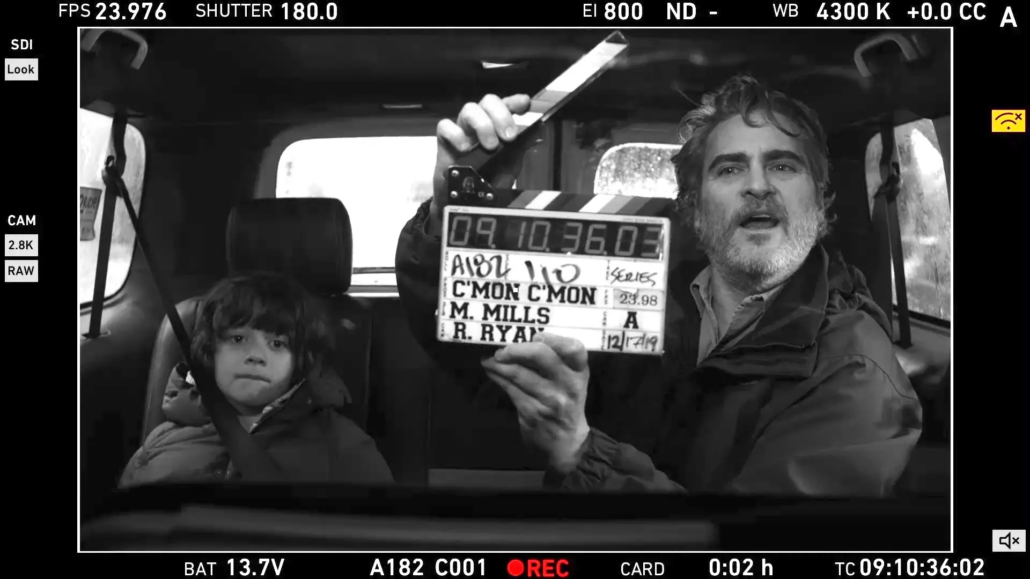
Today, we are celebrating the induction of select films from director Mike Mills’ body of work into the Criterion Collection as a collection titled I’ll Remind You of Everything, which compiles the director’s deeply personal, semi-autobiographical trilogy of films mapping out parent-child relationships, including Beginners, 20th Century Women, and C’mon, C’mon.
Other inclusions in this Mike Mills collection include:
- Audio Commentaries: Full-length audio commentary tracks by director Mike Mills on all three feature films.
- Bonus Short Films: Includes five of Mills’ prominent short films: Deformer (1996), Eating Sleeping Waiting and Playing (1999), The Architecture of Reassurance (2000), A Mind Forever Voyaging Through Strange Seas of Thought Alone (2013), and I Am Easy to Find (2019).
- Music Videos: Music videos directed by Mills for Air (“All I Need”) and Talking Heads (“Psycho Killer”).
The third film in the collection, C’mon, C’mon, features the work of our very own July featured alum, Academy Award-winning sound mixer Phillip Bladh. This is Phillip’s second film in the Criterion Collection; the first was Sound of Metal, for which he won a “Best Sound” Oscar.
Phillip shares an appreciation for C’mon, C’mon from his on-set perspective with us below, but first, let’s discuss what it means to be inducted into the Criterion Collection and what that process looks like.
What Does It Mean for a Film to Join the Criterion Collection?
For a filmmaker, being added to the Criterion Collection is considered to be the ultimate validation of artistic merit in cinema, serving as an official endorsement of a film’s cultural and historical importance.
Criterion’s curation has become the closest thing the movie industry has to an official authority, a.k.a a “Film Canon Stamp” of approval. Designating the films it inducts as essential masterpieces of cinema history.
When a film receives this metaphorical “stamp,” it means three things:
- Cultural Permanence: The film is elevated above standard commercial entertainment; it is no longer just a movie, but a piece of protected historical art.
- Academic Endorsement: Film scholars, critics, and universities instantly recognize the film as an essential study piece for future generations.
- Curatorial Prestige: It signifies that the film has survived a rigorous, highly exclusive vetting process by elite industry curators.
Receiving Criterion’s unique “Spine Number” on a Blu-ray or 4K case serves as the physical manifestation of this stamp—it permanently cements the film’s place in the official history of world cinema.
Once selected, Criterion works with a film’s director to create exclusive bonus features, audio commentaries, and video essays, sometimes even designing special packaging and booklets.
How Does the Criterion Collection Choose Its Films?
Criterion’s mission statement famously outlines just one rule: the film must be an “important classic or contemporary film.” It must be an exemplary film of its kind.
To decide what is historically significant, the Criterion team uses a loose set of subjective pillars:
- Cinematic Innovation: Did the film pioneer a technical or stylistic breakthrough? This is how movies like Citizen Kane (use of deep focus), The Thin Red Line (pioneering voiceover structures), or Sound of Metal (it’s approach and manipulation of sound) get recognized.
- For his work on Sound of Metal, Phillip won his “Best Sound” Academy Award.
- Cultural and Social Impact: Does the film serve as a vital time capsule for a specific era or social movement? Criterion actively searches for overlooked, subversive, or morally challenging films that shifted public discourse.
- Auteur Excellence: Is the movie a defining blueprint for a specific director’s artistic vision? Even if a movie flopped at the box office, it is deemed significant if it represents a filmmaker pushing the boundaries of the medium.
- The “Exemplary” Rule: Criterion does not require a movie to be high-art. A horror movie like Halloween or a pop comedy like Pee-wee’s Big Adventure can be historically significant simply by being the absolute best, most definitive example of its specific genre
Which Directors Have the Most Films in the Criterion Collection?
The collection heavily favors directors with massive, globally influential filmographies. The three filmmakers with the most representation are:
- Ingmar Bergman (46 films) — The legendary Swedish auteur dominates the catalog. Criterion released a massive, definitive box set containing 30 of his essential masterworks, alongside individual releases in 2018.
- Stan Brakhage (56 films) — Though his works are short avant-garde pieces rather than full-length narrative features, this American experimental filmmaker has more individual titles preserved by Criterion than anyone else.
- Akira Kurosawa (30+ films) — The master of Japanese cinema is a pillar of Criterion’s history. Landmark films like Seven Samurai and Rashomon helped build the boutique label’s reputation in its early LaserDisc days.
What Was It Like to Mix Sound for C’mon, C’mon? (An LAFS Alum’s Story)
By Academy Award-Winning Sound Mixer Phillip Bladh
I was slated to film two low-budget horror films back-to-back in LA in the fall of 2018.
I was midway through the first one when I got the call to work on C’mon, C’mon.
At the time, it was simply called “untitled Mike Mills movie,” a pretty common way of naming projects in the film industry until a final title is selected.
They were interviewing a few local LA sound mixers at the time.
I was sent the script and was shocked by what I read.
This is a movie about a sound mixer.
The lead character, Johnny, to be played by Joaquin Phoenix, was an audio documentarian.
In the movie, he is contacted by his estranged sister to come and watch over his 12-year-old nephew, Jesse, for a few days while she deals with a personal crisis involving her husband’s mental decline. A few days turn into a few weeks as Johnny and Jesse bond and end up traveling together for work.
They share a heartwarming adventure, recording the sounds of the cities that they visit together. All the while, Johnny works at capturing the thoughts of the youth of the new generation on their trusty recorder.
When I first met Writer/Director Mike Mills at his office in L.A. to interview for the job, one of the first things he said to me was “I want no carts on set”.
This is a very interesting request, as we usually rely on our carts to help transport all the heavy gear on set. Typically, you have a large cart with camera lenses and video monitors for an essential group of 10-20 producers and department heads, all watching intently as the movie is made.
Mike wanted none of that; he wanted only iPads and nothing else.
A truly scaled-down, mobile experience.
Then, I found out he was looking for a sound team that could travel with him for the duration of the film. First, we would film in L.A. for a month, then in New York City for three weeks, next travel to New Orleans for a few weeks, and then to Detroit for a couple of days.
In addition, I was to be involved as a consultant with the props department to help ensure the sound gear that Joaquin was going to use was in working order. His character was to have a sound bag and a boom mic, which he would carry everywhere that he and Jesse went. Actually recording sounds in various locations. His gear needed to be real working props.
I agreed to all terms and promised to work hard to help Mike make the movie the way he envisioned. After a few days, I was told I had the job.
Our first month of the shoot was in L.A. Monson Douglas was the boom operator with whom I was fortunate to work. Every morning, they would bring me the prop sound bag to jam timecode with a small concealed lock-it box.
I would also set up a wireless transmitter, exactly like the ones that I put on the actors for the film sound, from the output of the prop recorder as well. This would give me the ability to control the recordings on my end when we conducted the interview portion of the film shoot.
The rule was that if they could hear through the headphone output of the prop sound gear, it was also working on my end, reassuring them that everything was working as it should so that they could focus on the acting.
I would mix the output channel to my recorder.
Both sound cards would be delivered to the post-production team at the wrap of every night.
Woody Normand, the actor hired to play young Jesse, was 12 years old and a minor. Therefore, because of child labor laws, he could only work 7-8 hours at a time.
When you watch the movie, a large portion of it takes place while Joaquin Phoenix’s character is at work, hosting a series of Q& A sessions with real-life teens. These were filmed as splinter-unit shoots that were worked around the main unit of all filming.
In a film, you typically have three crews,
- Main Unit: The primary team led by the film’s director, capturing the main action and principal cast.
- Second Unit: A larger secondary team that typically operates completely autonomously with its own director and director of photography (often for stunts or establishing shots).
- Splinter Unit: A much smaller sub-team—often just a camera and small sound department—that operates under the main unit’s direction to grab quick, isolated shots
On most days, Mike Mills (Director), Robbie Ryan (Cinematographer), Rachel Jenson (1st AD), and I would convene 2 hours before call time and travel to conduct an interview or two for the film (Joaquin’s Q&As), then meet back up with the main crew to film for eight hours with the main crew.
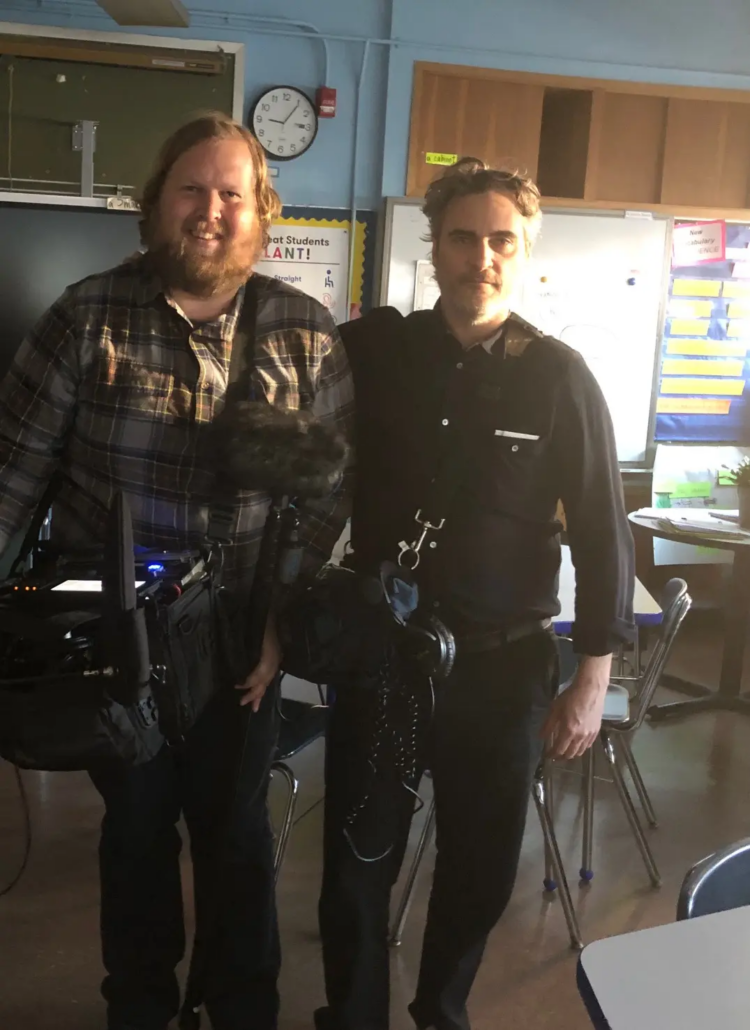
After Woody’s day was wrapped, we would sometimes splinter off again and do another of the film’s Q&A interviews.
It was a whole new way to work on a movie that I had never done before.
There was a day that we filmed at Venice Beach, here in California, with all the wild and crazy walks of life on the boardwalk and then on the beach. We were able to record a lot of it with Jesse recording it straight to his prop sound bag. A big win.
In New York, our first day was filming under a bridge, capturing the sound of skateboarders echoing in tall concrete archways.
A funny story from that day, the crew had all been tasked with writing down our name and the name of our favorite muppets, mine was “Phil Fozzie.” During this shoot, Mike was the hilarious and unfortunate victim of paparazzi pictures of him directing his heart out with a name tag that said “Mike Animal.”
To capture some of New York sounds, I took a small portable recorder with me on the subway and around the city. Unfortunately, since it was Christmas time there were lots of ringing bells and holiday carols blasting out of sound systems.
The most challenging scene of the film was done on the streets of NYC one afternoon where we had to shut down a busy intersection and shoot a scene where Jesse storms off in anger and gets on a bus. Johnny has to run across the busy city street, dodging traffic and danger, to get on the bus next to Jesse before the doors close avoiding them getting separated and potentially lost.
In order to accomplish this, our location, ADs, and art departments had to carefully organize the scene so that the background actors, stunt cars, and bus driver could all work together seamlessly and effectively to make the scene work in real time. While at the same time avoiding any dangers that might occur.
There were lots of moving parts, and as a sound department we had to find a way to start out on the street and make our way across it with the actors and onto the bus to ensure that their lines were captured cleanly and precisely, without ever getting in their way or messing up the scene.
We rehearsed with my sound bag already on the far side of the street with my long range antenna. The plan was to follow Joaquin onto the bus and continue to transmit as the bus drove away, the extra blocks it would take to finish the scene–the aftermath of the emotional meltdown he and Jesse had just experienced.
While rehearsing the scene we had been informed that bad weather was coming in and it was about to blizzard. We started shooting the scene as soon as it was possible.
Thankfully, it all went perfectly, except I was not able to get in the bus safely and had to abandon our plan to capture their post meltdown lines. I listened from the street watching the bus drive away as they slowly went out of audio frequency range, their voices dropping out.
As soon as the bus came back it started to snow and we couldn’t continue filming in the bad weather.
These are real things you deal with on set. Preparing and coming up with a plan, but then having to pivot due to events and circumstances. And then there are the curveballs from mother nature, where the weather may change or delay the plan completely.
After a short holiday break, we continued to film in New Orleans.
We filmed a lot more walking around than most of the other locations because Mike loved the way it looked and felt and it shows in the movie. There was a staged Mardi Gras style parade with a live marching band in a scene that was so loud that we staged our mics 2 or 3 houses down the road in order to record at acceptable levels.
Another thing you might notice, if you watch the movie, is that there are a lot of scenes between actors on phone calls.
The film was very focused and planned, but still required a lot of improvisation.
I was tasked with figuring out how to record these “phone conversation” scenes properly between the two characters.
After many tests, it was decided that it’d be best to start a three-way voice call with my phone acting as the in-between recorder. When queued, I would call the character on camera and they would answer when the prop phone rang in real time. All the phone conversations that you hear in the movie were recorded on set. Sometimes with the off camera actor calling from halfway around the world.
We wrapped in New Orleans, which were Jesse’s last scenes of the film. As a gift Joaquin gave him an electric bass signed by Flea from the Red Hot Chili Peppers, one of his favorite bands.
Next we spent a few days in Detroit, Michigan which acts as the opening few minutes of the film.
These Detroit shoots were windy night shoots in February, requiring three jackets and two hats to keep warm. On Friday of that week’s shoots, we wrapped and Joaquin won his Oscar for the Joker that Sunday in 2020.
Less than a month later everything was shut down for the Covid-19 pandemic. None of us saw that coming.
A few words about working with Writer/Director Mike Mills:
By now, I’ve worked on a lot of films in my career, and working with Mike was a really refreshing experience.
- For starters, he rarely ever yelled action or cut.
- To start a scene he would say “when you’re ready” and the action would simply unfold.
- Never before or since have I encountered that gentle style of filmmaking. He would often come up to me and say “thank you.”
- He would also often play music on set that was from The Cure, The Band, or scores from movies he loved.
- He once helped carry our heavy pelican case to the next location.
Working on his project felt a lot more like making a big painting. We were all working on it together and we all got to hold a brush and contribute. I felt that we were making true art.
Lastly, a few thoughts about working with lead actor Joaquin Phoenix:
When I first met Joaquin, I went to his trailer to introduce myself and I reached out my hand to greet him and he said “I don’t shake hands.” Respectfully, I withdrew and he jokingly said “I hug” and gave me a big bear hug.
He was very sweet and professional.
Several times we had our mic returned to us and it had obviously been taken off and folded neatly with great care and respect.
We always had his full support with making adjustments.
He and I spoke at length about the gear.
There is a scene early in the script where Johnny (Joaquin) is explaining the gear to Woody (Jesse). Right before we rolled, I walked Joaquin through a few key points as to what the recorder was. I said “this is the limiter, these are the faders, and this is the mic gain” and when we shot the scene he said exactly what I had just explained to him, nailing it! It made it into the final cut of the movie.
In 2024, years later Joaquin and I reunited on the set of Ari Aster’s epic movie Eddington in New Mexico. He remembered me and we continued to have a great working relationship together on a very different type of project. I asked him one day late in the film shoot if he would sign my copy of C’mon, C’mon, and he said “Of course”.
On his last day of filming, he handed my blu-ray to his assistant with a post-it note on it that said “For Phil, sound mixer.” It was returned to me a few hours later, with a note written on it “I only had to ADR 3 lines. I love you for that and for always being so kind -Joaquin.”
ADR in film stands for Automated Dialogue Replacement, sometimes it’s also called “looping”. It is the post-production process of re-recording an actor’s spoken lines in a quiet studio to replace the original on-set audio. Filmmakers use ADR to fix technical issues, remove background noise, or change dialogue entirely. It’s a big deal if there is little-to-no ADR work after a film is wrapped, actors and filmmakers appreciate less extra work at the end.
If I get asked what my favorite movie that I’ve ever worked on, it is easily C’mon, C’mon.
It was pure joy and fun to work on and when I find people who have seen it and love it’s always a great movie to have been a part of.
I’m excited that it is being honored by the Criterion Collection.
With Sound of Metal, it’s now the second film that I’ve worked on that is in the collection and both are interesting sound movies too. They both required very special approaches to capturing and building the sound for their stories.
If I were to do a special double feature screening of movies that I’ve worked on, it would probably be these two.
Where Can You Learn the Craft Behind Award-Winning Films?
The films that earn a place in the Criterion Collection are defined by craft — bold choices in storytelling, cinematography, and, as Phillip Bladh’s work on C’mon, C’mon and Sound of Metal shows, sound. Behind every “important classic or contemporary film” is a team of skilled artists who trained, experimented, and mastered their tools.
That training is exactly what The L.A. Film School is built to provide. Learn filmmaking from script to screen in our Film program, or earn your Digital Filmmaking degree online from anywhere in the world. And if it’s the art of sound that speaks to you, as it did for Oscar winner Phillip Bladh, explore our Audio Production program on campus or online.
Request Info to explore our programs, or Apply Now and start building the craft behind unforgettable films.
FAQs: The Criterion Collection
What is the Criterion Collection?
The Criterion Collection is a curated library of films widely regarded as the closest thing the movie industry has to an official “film canon.” For a filmmaker, inclusion is considered the ultimate validation of artistic merit, an official endorsement of a film’s cultural and historical importance. Once selected, Criterion works with the director to create exclusive bonus features, audio commentaries, video essays, and often special packaging.
What does it mean for a film to be added to the Criterion Collection?
Induction signals three things: cultural permanence (the film is treated as protected historical art, not just entertainment), academic endorsement (scholars, critics, and universities recognize it as an essential study piece), and curatorial prestige (it survived a rigorous, exclusive vetting process). A film’s Criterion “Spine Number” on a Blu-ray or 4K case is the physical mark of that lasting place in cinema history.
How does the Criterion Collection choose which films to include?
Criterion’s mission names just one rule: the film must be an “important classic or contemporary film” and an exemplary example of its kind. In practice, the team weighs a loose set of subjective pillars: cinematic innovation, cultural and social impact, auteur excellence, and the “exemplary” rule — meaning a film can qualify simply by being the most definitive example of its genre.
Does a film have to be “high art” to join the Criterion Collection?
No. Criterion’s “exemplary” rule means a film doesn’t need to be high-art to be historically significant. A horror movie like Halloween or a pop comedy like Pee-wee’s Big Adventure can earn a place by being the absolute best, most definitive example of its specific genre. Even a box-office flop can qualify if it represents a filmmaker pushing the boundaries of the medium.
Which directors have the most films in the Criterion Collection?
The collection favors directors with massive, globally influential filmographies. The three with the most representation are Stan Brakhage (56 films, mostly short avant-garde works), Ingmar Bergman (46 films, including a definitive box set of 30 masterworks), and Akira Kurosawa (30+ films, with landmarks like Seven Samurai and Rashomon that helped build Criterion’s early reputation).
Who is Phillip Bladh, and how is he connected to the Criterion Collection?
Phillip Bladh is an L.A. Film School alumnus and Academy Award–winning sound mixer. He won the Best Sound Oscar for Sound of Metal, which is in the Criterion Collection, and he also worked on Mike Mills’ C’mon, C’mon, included in Criterion’s Mills collection titled I’ll Remind You of Everything. That makes two Criterion films to his name, both notable for their inventive approach to sound.
What does a production sound mixer actually do on set?
A production sound mixer captures clean, usable audio while a film is being shot, and adapts constantly to the realities of each location. On C’mon, C’mon, that meant traveling across four cities, rigging working prop recorders so the lead actor’s gear was real, capturing three-way phone-call scenes live, and problem-solving on the fly through crowds, traffic, and even a blizzard. Strong on-set sound also reduces costly ADR (re-recording dialogue) later.
