
Grammy Winner Jim Scott and Warner Bros.’ Paul Broucek Tell Students How a Music Career Actually Gets Built
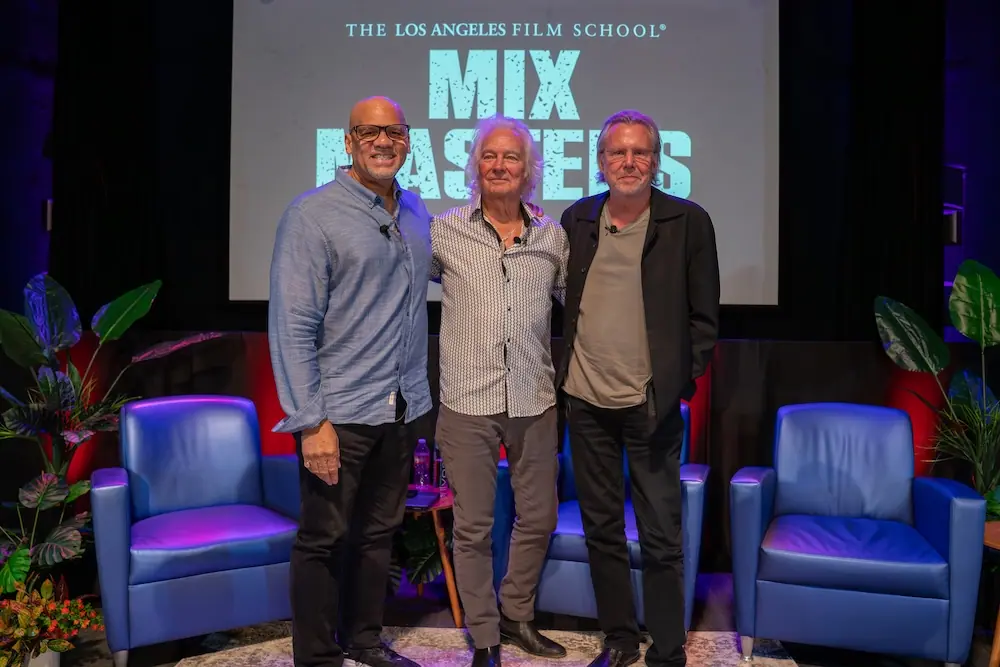
Featuring Jim Scott (Grammy-Winning Engineer/Producer) and Paul Broucek (President of Music, Warner Bros. Pictures)
There’s a version of a music career that looks clean on paper: graduate, intern, get credits, win awards. And then there’s the version shared in the room: careers built over time, through repetition, relationships, and being available when opportunity shows up.
According to Jim Scott and Paul Broucek, that path often begins in places most people don’t expect.
Scott shared that early in his career he started in entry-level studio roles in his late 20s, after already having worked in another field. He described early studio life as highly structured and observational, where learning happened by watching others handle (or mishandle) real sessions.
He recalled: “There was no jumping in at the top. You had to be trained. You had to watch other people crash a session and go, I’m not going to do that.”
Broucek described a similar culture of progression during his early studio years. He framed it as a test of commitment and persistence:
“It was a way of finding out if you were going to stick it out. If you’d put in years at minimum wage just to prove you were responsible enough to be in a room with the best artists in the world.”
He also shared an early career milestone involving live recording logistics at a major venue, describing being tasked with placing audience microphones in a high, difficult location before a show began. Reflecting on it, he said:
“Whenever I go to the Forum now, I look up and I can’t believe I did that.”
Relationships Matter More Than Gear
Scott emphasized that early opportunities often came less from formal advancement and more from trust built in prior interactions.
“The point of that story isn’t about me. It’s about the relationship I had with a young guy who was in over his head. I went over, did my best, calmed it down. And it was honestly the start of everything.”
He described being asked to help a fellow engineer who was overwhelmed on a project involving The Police, and stepping in to stabilize the situation so the work could be completed.
He explained that this relationship later led to a new opportunity:
“The point of that story isn’t about me. It’s about the relationship I had with a young guy who was in over his head. I went over, did my best, calmed it down. And it was honestly the start of everything.”
That collaboration eventually led to Scott being brought into work on Sting’s debut solo album, The Dream of the Blue Turtles, which became one of his early major engineering credits and contributed to his first Grammy nomination for Best Engineered Album.
The panel emphasized a recurring theme: technical skill creates access, but relationships shape trajectory.
As one moderator summarized:
“It’s not what you know. Sometimes it’s not even who you know. It’s who knows you.”
Broucek added a practical perspective on interpersonal skills in the industry:
“You have to be a really good listener. You have to like people. Know when to speak and when to get out of the way. Therapist skills, genuinely.”
How a Song Becomes Part of a Film
Broucek also discussed how contemporary film music decisions are shaped through collaboration between filmmakers and artists, using the example of Barbie.
“I can’t stand on-the-nose placement,” he said. “When you’ve heard the melody before and the lyrics speak to the story without spelling it out, that’s when a song really does its job in a film.”
He described how “What Was I Made For?” by Billie Eilish came to be part of the film’s soundtrack through collaboration between the filmmakers and the artists involved in the project.
He emphasized that the effectiveness of the song in the film came from how it was integrated into the score and story structure, rather than being added in isolation.
“I can’t stand on-the-nose placement,” he said. “When you’ve heard the melody before and the lyrics speak to the story without spelling it out, that’s when a song really does its job in a film.”
Stay Curious, and Prepare Before You Need To
“You’re never going to have done what you get to do next. So you have to prepare yourself. When the opportunity shows up, you want to be able to walk through that door.”
Broucek also spoke about career evolution in the music industry, particularly how shifts in technology often create new opportunities for those paying attention early.
He described becoming involved in emerging audio technologies in the early digital era, which eventually led him into roles beyond traditional studio engineering.
His central point was about readiness rather than planning:
“You’re never going to have done what you get to do next. So you have to prepare yourself. When the opportunity shows up, you want to be able to walk through that door.”
He also noted that in film music contexts, leadership often involves guiding collaborators rather than directing them, especially when working with filmmakers who are less experienced with music.
The Most Underestimated Role in the Room
When asked about overlooked roles in the industry, Scott was direct:
“The recording engineer.”
He described engineers as central but often invisible contributors:
“There are engineers all over the world staying up all night, recording everything, sorting it out, making it work, and they’re invisible. They don’t get paid that well. They’re responsible for everything. There has never been a record made without an engineer at some point.”
Broucek echoed this from the film perspective, highlighting the technical craft involved in capturing orchestral and cinematic sound, and how much it affects the final emotional impact of a score.
The Short Version
Both Scott and Broucek described careers shaped less by linear paths and more by accumulation: of skills, relationships, timing, and readiness.
Neither described shortcuts. Both emphasized early-career work that involved observation, repetition, and trust-building over time.
The takeaway they returned to throughout the session was simple: technical ability matters, but careers are built through consistency, curiosity, and the people who come to rely on you.
The gear matters. The room matters. But the relationships are what carry a career forward.
Ready to start building your future? Explore our programs.
