
From LAFS to ESPN: Meet Emmy-Winning Animator Maddie Goldberg
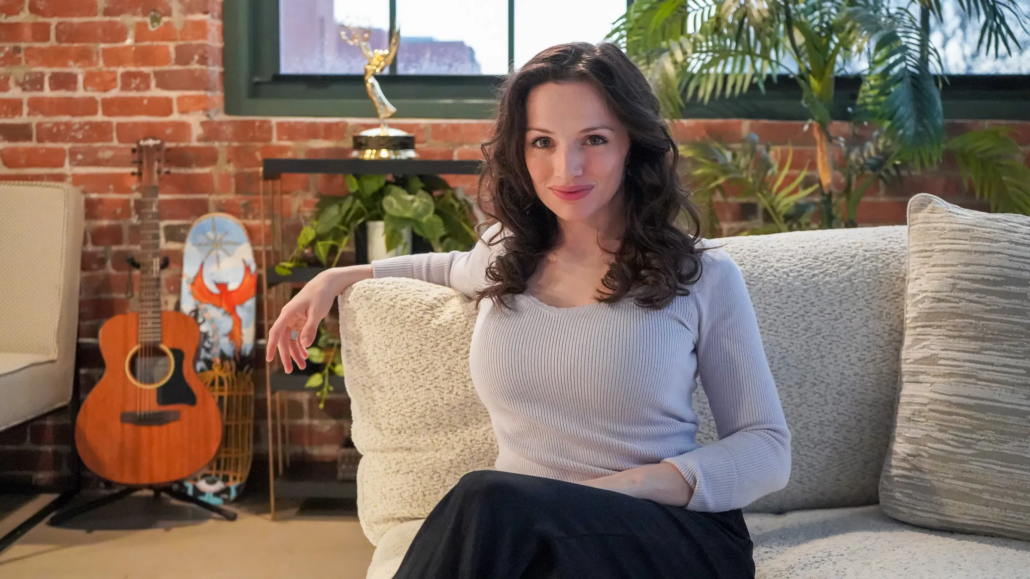
A 2022 graduate of the Animation Visual Effects program, who credits being prepared at all times as the key to landing an animation role at ESPN just months after graduating, when a chance encounter with their VP of Creative Studio turned into an opportunity to live out her animation dreams, winning an Emmy along the way.
Maddie Goldberg is an experienced motion designer, 3D animator, and multimedia artist based in Hartford, Connecticut.
Since graduating from The Los Angeles Film School’s Animation and Visual Effects program in 2022 with a Bachelor of Science, Maddie has gone on to win a Sports Emmy for her work on ESPN’s Toy Story Funday Football. She currently continues to work on ESPN’s digital activations for SportsCenter, College Football, and more.
A CREATIVE JOURNEY BEGINS…
Raised in a creative and musical household, some of Maddie’s earliest memories are of her father playing guitar regularly around the house. Her mother was also an artist, one who preferred oil paints as her medium.
This creative upbringing proved a safe harbor for her imagination–developing a creative compass that would lead her down the paths of artistry, filmmaking, and music. Her film career began in fourth grade, equipped with a movie camera, Windows Movie Maker, and later iMovie, she would make backyard productions–casting her friends to star in music videos that she would edit and share.
At 18, she began filming her school life while still a student at the prestigious Miss Porter’s School for Girls. Soon, she would receive requests to film and edit videos of events from the school clubs that she was involved with, which learned of her talents, giving her even more hands-on practice before reaching her teenage years. She also began dabbling in creating art films, where she continued to test different techniques.
FROM COAST TO COAST
Before attending The L.A. Film School, you also spent some time in New York, correct?
Maddie Goldberg: Yes. When I was 18 years old, during my senior year of High School, I learned of a filmmaker’s masterclass that B&H Photo and Video, a camera and video superstore located in Manhattan, was offering.
It was a two-to-three-week immersive program where you would learn from people in the industry and have the opportunity to make a film of your own with your assigned team.
So, I applied to that and sent them some of my editing. I got in.
Nobody there was my age. A lot of them were veterans with a ton of experience.
Was that your first time in New York?
MG: I do have family in New York, so I grew up periodically visiting the city; my Aunt and Uncle reside on the Upper East Side.
Through the masterclass, I was exposed to the city in a new light, doing my own thing, getting to know the film scene out there. I fell in love!
I said, “I have to be here. This is where I have to be.”
Wanting to stay in New York, I ended up going to film school at Pace University in downtown Manhattan. I was also doing freelance work in New York for B&H and ended up working for them on the side.
When did you begin to take an interest in animation?
MG: When I was at Porter’s, I taught myself Final Cut Pro. I think it’s when I switched to Final Cut Pro from iMovie that the world of animation opened up for me, and when I first learned how to use keyframes, everything just exploded from there.
I attended Pace when I was really starting to love animation, but they didn’t have an animation-focused program.
So, I said, “Let me see if I can transition here. I’m going to apply to some schools that actually have a concentration in animation.”
I continued to work as a freelancer and to live in New York for about 6 months, meanwhile applying to other schools.
During that time, I completed a two-week workshop at New York Film Academy focused on animation in Adobe After Effects. I also enrolled in a month-long workshop at the School of Professional Studies at New York University (NYU) for Cinema 4D to 3D Animation.
It’s great that you got to experience various programs and schools.
MG: I let my passion guide me.
I was never the type of person to think, “I’m going to go to this school for four years, they’re going to tell me exactly what to do, and I will walk away with everything I need to know for my future career”.
I intuitively follow my creative drive. I have something inside that says, “okay, we’re doing this now,” and then I just fill in the gaps, like, “okay, well, if I want to learn this, where can I find a program that teaches that?”
I decided on The LA. Film School’s Animation Visual Effects program after getting in, because it’s LA! I also really liked the school. I had done a tour before going to Pace in New York.
Why did you decide on Pace the first time around?
MG: While I was in New York, my freelance career really picked up, and I started doing animations for brands like Airbnb and Jordache Jeans. So initially, it felt right to remain in New York.
I met so many people in New York associated with brands, as well as many up-and-coming musicians, which led me to start designing a lot of album covers for music artists.
I’d use my Instagram account to showcase my projects and to get more work.
What did you like best about your experience at The L.A. Film School?
“I really liked how [LAFS] centered on one skill every month. I wasn’t trying to keep track of 10 different curricula in one week. It was truly quality over quantity“
MG: It was just a great experience!
I really liked how we centered on one skill every month. I wasn’t trying to keep track of 10 different curricula in one week. It was truly quality over quantity – just a very good setup for my brain.
Also, I don’t know if this is still the case, but while I was going there, classes were one day on, one day off– meaning that you go to school one day and have the next day off, giving you the time to do the work, and then you go back the following day.
THE SOUL OF AN ARTIST
You are also a singer/songwriter, right?
MG: Yes. Thank you for asking about it!
It’s funny, I do all this stuff behind the scenes, but I love being in front of the camera,
I’ll be the first to say that I loved being the center of attention from a young age.
I still record music and make videos for my own tracks, often under an alias, which serves as my primary creative outlet outside of work.
Music is how I express myself. I learned to play the drums, guitar, and piano from a young age.
Even now, when I get home after work, I go into songwriter mode. It’s like something moving through me. There’s something that is begging to be expressed, and the songs and music kind of make themselves. Honestly, if I didn’t have this career in animation, I would be doing music.
What’s interesting is, I often feel a little weird about saying that I’m a musician, or weird about saying that this is a huge part of how I express myself, because I have so much success in a different area. But the truth of the matter is, music informs animation. Animation informs music, music informs life. It’s all cohesive, and some of my biggest inspirations have the coolest music videos I’ve ever seen.
You must’ve loved being so close to so much access to music while at The L.A. Film School, with our Los Angeles Recording School here and our Hollywood location?
MG: Yes! I would often scooter over to the recording school after class to meet my music friends and play around in the booth! I learned to collaborate with musicians and producers to create unique, personal tracks.
While in LA, I fell in love with FKA twigs, who is an artist who not only sings, but is very involved in the making of her music videos. She studies art forms and how the body is art itself. I had the opportunity to see her live, and I went to her signing at Amoeba.
She’s actually a great example of an artist who creates incredible music videos that I admire so much.
Did artists like her inspire your thesis project for The L.A. Film School?
MG: Absolutely! Twigs videos like “Cellophane” and “Two Weeks” brought loads of inspo for my final project at The L.A. Film School.
For this project, I animated a 3D video in Maya to a song I wrote and performed. The song was produced at Downright Music and Art, where I had learned guitar, piano, and drums growing up.
“Everything I learned at The L.A. Film School is likely because I spent a lot of time in the lab, and I asked teachers questions when I didn’t know things. It’s so important to ask questions.”
The video features a gold statue of a girl in the middle of a ballroom with gold wires all over her.
I animated every single wire to form as the song is playing, forming to the beat of the song. I accomplished this by using different shots and renderings.
In total, it was a six-year journey with this concept of what would become my final Animation Project. I wrote the song in New York in 2017, recorded it officially in Connecticut in 2020, and made the music video at the labs in Los Angeles.
Everything I learned at The L.A. Film School is likely because I spent a lot of time in the lab, and I asked teachers questions when I didn’t know things. It’s so important to ask questions.
My video project came together beautifully, and what’s funny is that this is actually the piece of work I showed the person from ESPN that led to me getting my current role.
BOLD ACTIONS REAP BIG REWARDS
That’s amazing. How did that meeting with ESPN come about?
MG: I always keep a folder with examples of my work on my phone. I really recommend that all creatives do this. This way, you are always ready if an opportunity like the one I had comes around. No matter who you meet, when you’re networking or just out away from your computer, you can pull it out, and your work is right there, easy to get to.
As I mentioned, my Dad was a musician, and I was introduced to the VP of Creative Studio, Spike, at one of his gigs in Connecticut.
I remember that I wasn’t even going to go to this event. I was tired, but I said, “What the heck, I’ll just show up and support my dad.”
My dad had met him that night, and then I walked into the room, and my dad introduced us.
“The number one thing that I say to everyone is that preparation plus opportunity equals success.”
I pulled out my phone. I had my project on it. Spike’s also a musician, as well, so he saw me as a human, right? He saw not only that I had these animations to show him, but that it was a project that I’d put everything into. My heart is in it with the lyrics, my music is in it, my animations are in it.
Everything that I had learned at The L.A. Film School is in it too, because I spent a lot of time in the lab, I asked teachers questions when I didn’t know things, and I got it done, and here I am showing it to Spike from ESPN, right?
And he’s seeing all of that in that moment at a music venue at a show, because I was prepared– because I had it all ready on my phone.
Spike said, “We have an animator position potentially opening. Let’s do an interview.”
And now I’ve been at ESPN for four years. I’m doing all of these cool things!
The number one thing that I say to everyone is that preparation plus opportunity equals success.
We love that story! So at that time, you had moved back to Connecticut?
MG: So, I was in LA, excited to be there. I thought I was going to work there. However, the pandemic happened while I was at The L.A. Film School in 2020.
All of the classes shifted to online once COVID hit, and I felt really isolated living in my little apartment on North Cahuenga Boulevard and Franklin Avenue. So, I moved back to Connecticut, finished my education in my parents’ home, and I met Spike from ESPN in 2022, the year I graduated.
ESPN is based in Bristol, Connecticut, so I’m currently here, although my fiancé Ian and I are in no rush to plant roots in case an opportunity in a different city comes our way!
What are some of your favorite projects that you’ve worked on at ESPN?
MG: My work in Cinema 4D, augmented reality (AR), working with Pixar, collaborating with the NFL, casting a Toy Story activation, the Emmy win–so many things!
I mostly work in Unreal Engine. Right now, I act as environment designer and animator for a show called SportsCenter on the Road, which is sponsored by GEICO.
So, we come up with these integrations. We have a big virtual digital twin of the actual SportsCenter set – basically a to-scale SportsCenter set in 3D. I’ve worked on many scenes where the little GEICO gecko gets in his little car and drives through the 3D studio into various environments that I create in Unreal Engine.
How would you describe your creative process?
MG: I put together the vision first.
For environment building, I’ll go onto Google Maps if it’s an existing location that I’ll need to replicate and look around to see what the area looks like, buildings, etc. Then, I try to model what I can and re-create those roads.
In this scenario, where I’m building environments I visualize, I get a sense of the scene, and then I go in and whittle down the specifics. I always have the vision first. I don’t just start from nothing.
Animation is one of those professions that continuously evolves technologically. What is one of your favorite new tech advancements that you currently work with at ESPN?
MG: So true. It is constantly evolving. We have a ton of new advancements on the virtual production side.
In one of our studios, we have a large LED volume where we can import our virtual 3D environments and stand in them. So, basically, I can create a 3D world, put it on the LED screen, stand in it, and then they can film that!
That’s one of my favorite advancements that we have now.
LED screens are being used even more than green screens in professional productions nowadays.
What software products do you use most in your current role?
MG: I use Unreal Engine currently.
I used to use Cinema 4D a lot as well, but now, with everything I do with virtual and real-time productions, I use Unreal more.
THE FUTURE OF ANIMATION
How do you feel about AI? What role does it play in your role?
MG: With AI, I like to be careful when I talk about it. It’s a very polarizing topic.
I started experimenting with AI in 2021. Back when you had to use code, and there weren’t as many user interfaces (UIs) out there.
In terms of image generation. I used Stable Diffusion, Hugging Face… I’ve also used Google Colab Notebooks to try to figure out how to use code to augment and generate images.
When it comes to AI, for me personally, I think the greatest use case is pre-visualization.
Ten years back, when someone was talking to an art director, and the art director was trying to get their vision across, the director would see something so clearly in their mind, and they had to explain it, or try to draw it, or have an artist or designer draw it. And rounds of feedback later, they might have something close to what was in their head.
Now, you can type into an image generator the thought in your mind, and then you can just say, tweak that, tweak that, and then suddenly, you can have the exact image that was in your mind. Maybe even better.
And then you show that to a 3D artist, and you can build from that idea.
At ESPN, we are not making things with AI and airing them. That is not legal.
But it can be handy for visualization.
We need people who know how to use AI.
I recommend that instead of being fearful that it’s going to take your job, that you learn how to use it, because there are going to be prompting jobs.
There are going to be jobs based around being able to talk to certain large language models, and the more that you get your feet wet now by being able to prompt, the better off you will be in this evolving tech landscape.
I equate it with the Industrial Revolution, when trains were made, or factories. People were freaking out, but it’s just another evolution in life.
Lastly, in terms of AI, there’s a lot more research to be done on the environmental impacts. I admit that I was very pro-AI, but I do also know that I need to do more research into how it’s affecting the environment daily.
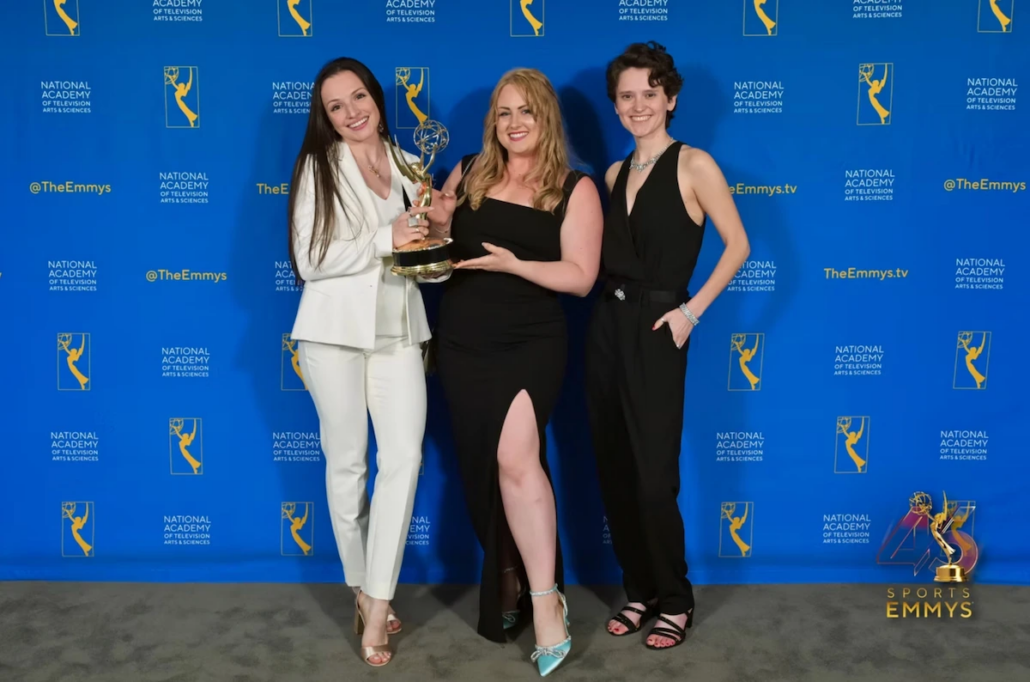
Congratulations on your Emmy! What did winning that feel like?
MG: Yeah, it was crazy! Definitely a thrill, and for some reason, it felt right to me to be there, and that it was a sign that I shouldn’t give up, and I should keep going.
It felt surreal, but I didn’t feel out of place.
I felt like I was surrounded by more creatives and people who have put in as much work as I have. I remember getting my pictures taken on the red carpet and then getting on the stage. It was the Sports Emmy Awards, so it wasn’t super overwhelming. There weren’t any actors in the crowd, but it was still very cool.
What is your advice to aspiring animation students?
“You’ll be surprised at how much help you get when you admit that you are still learning; people will understand.”
MG: Don’t pretend that you know what you’re talking about if you don’t.
You’ll be surprised at how much help you get when you admit that you are still learning; people will understand.
ESPN has felt like a master’s in animation to me.
The L.A Film School was my bachelor’s. I learned so much there, and that experience helped me to get this great job, but I continue to learn every day here with the work that I do.
I still go to people when I have a question.
As you get to know people and what they do, you’ll find that they will help you.
People are people, and the most surprising thing is how much help you will get the more open you are. Instead of pretending you know everything, let them know that you are still learning and you’ll get the help you need.
“The learning never stops. That goes for anyone in any industry, but especially animation.”
Find out more about our animation degree programs.