
Strange, but brilliant: How adult cartoons stopped playing by the rules
Bright colors. Bold lines. Wacky voices. For decades, animation was seen as the safe zone of childhood—home to Saturday morning escapism and toy-selling mascots.
But somewhere along the way, the crayons got darker. The jokes got sharper. And the stories started to look a little too familiar to adult life.
From Homer Simpson’s lazy drawl to Rick Sanchez’s nihilistic rants, adult animation has carved out its own corner of culture.
These shows make us laugh at politics, squirm at taboos and sometimes even confront the darker sides of ourselves. They prove that cartoons can be satire, tragedy and philosophy all at once.
How did animation make the leap from kids’ playgrounds to grown-up conversations? Let’s take a closer look at the milestones that turned cartoons into a safe space for adults too.
The early days
For much of the 20th century, animation was seen as the domain of children.
Studios like Hanna-Barbera churned out family-friendly staples such as The Flintstones and Scooby-Doo, while Disney perfected the formula of magical storytelling on the big screen. Saturday mornings were sacred—reserved for cereal, pajamas and brightly colored cartoons designed to entertain kids and comfort parents.
But in the background, a different kind of animation was in creation. Underground artists and independent filmmakers began to see the potential for more provocative storytelling. Ralph Bakshi’s Fritz the Cat (1972) became notorious as the first animated feature to receive an X rating, using anthropomorphic characters to tackle the counterculture head-on. It was shocking, controversial—and undeniably adult.
Meanwhile, experimental shorts and international projects—like the surreal Czech animations of Jan Švankmajer or the adult-oriented anime emerging from Japan—proved that animation didn’t have to be sanitized for young audiences. These works may not have been mainstream hits, but they planted the seed that cartoons could be art and rebellion all at once.
Though still considered niche, this early wave laid the groundwork for the incoming cultural shift. It showed that animation had limited possibilities—and was waiting for the right moment to break into the mainstream adult consciousness.
The Simpsons: Animation grows up on primetime
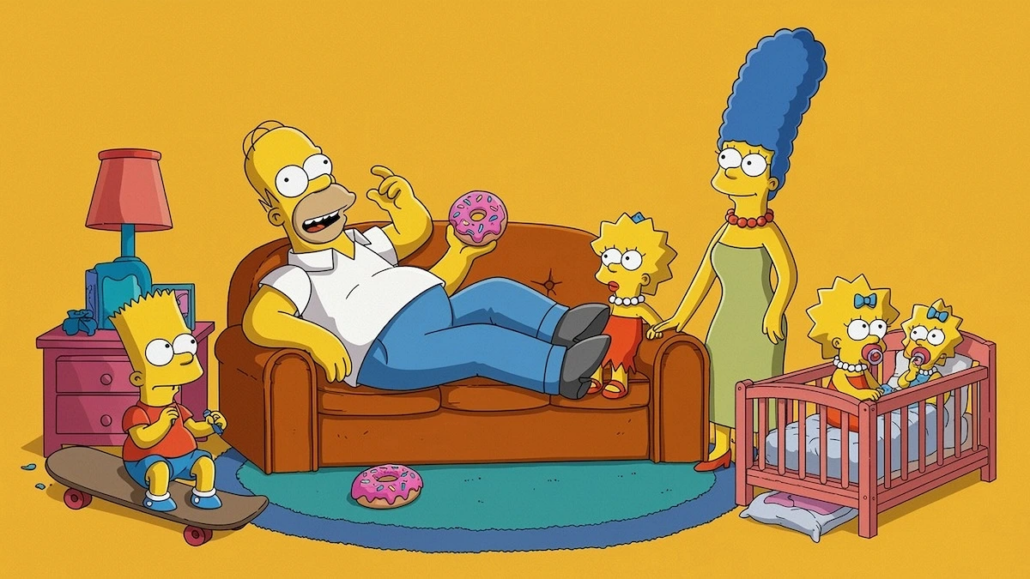
In 1989, American television changed forever when a dysfunctional family moved into primetime. The Simpsons wasn’t the first animated show aimed at adults—but it was the first to crack the mainstream in a way that proved animation could be just as culturally relevant as live-action sitcoms.
What began as short interludes on The Tracey Ullman Show quickly grew into a phenomenon. With Homer’s “D’oh!”, Bart’s rebellious catchphrases and Marge’s exasperated sighs, The Simpsons became a mirror of American family life—only skewed through sharp satire and absurdist humor.
These characters didn’t learn neat moral lessons. They bickered, schemed, failed and somehow stayed relatable in all their flaws.
The show also proved animation could be timeless. While live-action sitcoms dated quickly, The Simpsons created a universe that could parody politics, pop culture and social trends year after year.
More than three decades later, The Simpsons still holds its place in television history. It wasn’t just a cartoon; it was proof that animation could grow up, move into primetime and never look back.
South Park: Pushing boundaries
If The Simpsons opened the door for adult animation, South Park kicked it wide open—and then set fire to the welcome mat.
When Trey Parker and Matt Stone’s crudely animated series premiered in 1997, audiences were stunned. The show’s cut-out style looked deliberately primitive, but the writing was razor sharp, mixing shock humor with biting social and political satire.
Nothing was off-limits. South Park skewered religion, celebrity culture, politics and current events with a level of irreverence that no live-action sitcom could get away with. Episodes were written and animated in as little as a week, which meant the show could make use of breaking news almost in real time.
Of course, the controversies came quickly. Parents’ groups protested, politicians condemned it and TV watchdogs tried to clamp down. But all the outrage only cemented South Park’s reputation as the show that said the quiet part out loud. Adults who once dismissed cartoons as “kid stuff” suddenly found themselves tuning in to hear what four foul-mouthed fourth graders would say about the latest headline.
The 2000s boom
By the early 2000s, adult animation had moved from curiosity to cultural force. Family Guy—which debuted in 1999—took the satirical foundation of The Simpsons and turned it up several notches. Its cutaway gags, rapid-fire pop culture references and boundary-pushing humor made it a cult favorite.
Though briefly canceled, fan demand (and strong DVD sales) brought it back, proving that audiences were hungry for irreverent, offbeat animated comedy.
Meanwhile, cable networks carved out their own late-night niches. Cartoon Network’s Adult Swim block, launched in 2001, became a playground for the bizarre and the experimental. Shows like Aqua Teen Hunger Force, Robot Chicken and The Venture Bros. embraced absurdity, surrealism and DIY aesthetics that would never fly on primetime TV. For a generation of insomniacs and college students, Adult Swim was vital viewing.
This boom demonstrated the sheer range of what adult animation could be: from parody-driven sitcoms to surreal sketch comedy to sprawling cult classics. By the end of the decade, animation was a thriving ecosystem, constantly reinventing itself and expanding what cartoons could mean for grown-up audiences.
The Bojack Horseman
Bojack Horseman reminded us that sometimes laughing hurts. When the series premiered on Netflix in 2014, it looked at first like another quirky adult cartoon—a washed-up sitcom star who just happened to be a horse, stumbling through Hollywood’s excess and absurdity. But beneath the pastel colors and gags lay something few expected: raw, unflinching explorations of depression, addiction, trauma and self-destruction.
Bojack Horseman dared to ask whether people—or horses—can truly change. Episodes blended absurd comedy with heartbreaking moments, using surreal animation to depict panic attacks, substance abuse and the crushing weight of fame. One episode was almost entirely silent, another played out as a single, uninterrupted eulogy. The show constantly pushed the boundaries of what storytelling in animation could look like.
Critics and audiences hailed it as a turning point. Animation could deliver character-driven drama on par with the most acclaimed live-action series. In its willingness to tackle mental health and existential despair, Bojack Horseman proved that adult animation could be profound and empathetic.
Science, surrealism and streaming
If Bojack Horseman was the heart-wrenching drama of adult animation, Rick and Morty was its anarchic, interdimensional brain. Since its debut in 2013, the show has combined high-concept sci-fi with gleefully dark humor, weaving together multiverse theory, body horror and bleak philosophical musings—all wrapped in the chaotic relationship between a nihilistic scientist and his anxious grandson.
The brilliance of Rick and Morty lies in its balance. One moment, it’s parodying Back to the Future; the next, it’s delivering a gut punch about the meaninglessness of existence—or, occasionally, the fragile beauty of it. Its mix of absurdity and existentialism turned it into a cultural phenomenon, spawning endless memes and fan theories.
At the same time, streaming platforms were transforming the landscape. Netflix, Hulu and Amazon Prime invested heavily in original animated content for adults, producing series like Big Mouth, Disenchantment and F is for Family. Internationally, anime continued to influence tastes, blurring the line between niche fandom and mainstream appeal.
Why adult animation just works
So what makes adult animation so enduring—and so effective? At its core, animation offers a kind of creative freedom that live-action can’t always match.
Characters can be exaggerated to absurd extremes, worlds can defy the laws of physics and satire can land harder when it comes from the mouth of a cartoon character rather than a flesh-and-blood actor.
That freedom allows creators to tackle taboo subjects without flinching. South Park could use religion and politics material more ruthlessly than any sketch comedy. Bojack Horseman could explore mental illness with a surreal visual language that brought inner struggles to life. Rick and Morty could confront existential despair through alien landscapes and alternate dimensions.
Animation’s elasticity makes it uniquely equipped to handle both the ridiculous and the profound.
Final thoughts
From underground experiments to global streaming hits, adult animation has carved a permanent space in popular culture. What started as a rebellious counterpoint to Saturday morning cartoons is now a thriving creative force that spans genres, platforms and audiences worldwide.
As technology evolves and new voices emerge, the genre will only continue to expand—telling stories that are funnier, weirder and more emotional than ever before.
Want to create your own animated stories that break the mold? Explore our animation degree programs at The Los Angeles Film School and start shaping the future of the genre.