
From LAFS to Hollywood: How Joshua Bramer Became the Prop Master Behind Everything Everywhere All at Once, Euphoria, Don’t Worry Darling, and More
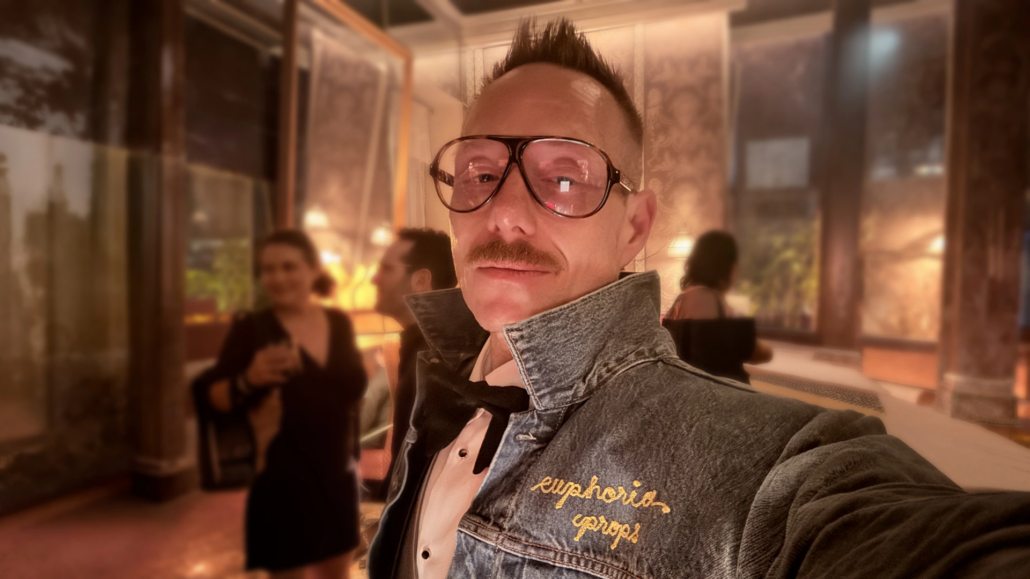
Hollywood Property Master Joshua Bramer shares his journey from film student to working on acclaimed productions like Everything Everywhere All at Once, Euphoria, and Don’t Worry Darling—plus advice for aspiring young professionals entering Hollywood.
Long before he became an in-demand Hollywood property master working on acclaimed productions like Everything Everywhere All at Once, Euphoria, Freakier Friday, and Blonde, he was a kid in Michigan, completely fascinated by movies like Hook and Jurassic Park, watching behind-the-scenes bonus content behind his favorite films, which he hoped would reveal how movie worlds were created.
Today, Joshua Bramer helps create those worlds himself—designing and sourcing the props that bring characters, stories, and entire universes to life onscreen.
From recreating Marilyn Monroe’s world for Blonde to crafting the unforgettable props behind Everything Everywhere All at Once and fan-favorite Euphoria, The Los Angeles Film School alum has built a career helping create the visual magic audiences fall in love with onscreen, just like he did as a kid.
But his journey into Hollywood didn’t begin with props at all.
In this exclusive Q&A, Joshua shares how a spring break trip to California changed his life, why staying open-minded shaped his career, and what it’s really like working behind the scenes on some of Hollywood’s biggest projects.
What first made you fall in love with filmmaking?
Joshua Bramer: Growing up, I was obsessed with movies–but I didn’t really understand how they were made. Jurassic Park was my favorite film as a kid. I loved the dinosaurs! I had the VHS tape and watched it over and over. Seeing this world that filmmakers created, it completely immersed me.
“I Thought Movie Magic Was Real”
I also loved magic specials and movies like Hook. As a child, I genuinely believed some of that stuff, like flying through the air, was possible. Then I started watching behind-the-scenes specials on HBO and realized filmmaking was basically movie magic created by artists and technicians. That’s where the fascination really began for me.
That was the moment when I realized filmmaking was like magic.
Another standout moment that made me want to pursue this as a career was when, while in Michigan, I ended up on the set of Extreme Makeover: Home Edition. Seeing a real production set completely changed my perspective. There were trucks everywhere, crew members moving nonstop, cameras, equipment, and how many people it took to make something happen—it suddenly clicked that this was a real career path.
It’s also when I started thinking, “People actually do this for a living!”
Did you always know you wanted to become a prop master?
JB: Not at all. I actually thought I was going to work in sound mixing after graduation.
At LAFS, I worked on a lot of student productions doing sound and post-audio work while I was in school. I really enjoyed it, and for a while, I thought that was the direction my career would go.
How did you discover The Los Angeles Film School?
JB: In 2009, I came out to California during spring break to visit family and fell in love with Los Angeles.
When I got back home to Michigan, I started researching film schools and found The Los Angeles Film School. The idea of learning in Hollywood, where movies are actually made, was really exciting to me. A little terrifying too, making such a big move.
My twin brother and I packed everything into his Ford Escape and drove across the country so I could attend school here.
What was your experience like at LAFS?
JB: What I appreciated most was how hands-on everything felt.
The school exposed us to every department in filmmaking, so every month I was learning something different. That was incredibly valuable.
I met people who were passionate about directing, cinematography, editing, sound, and production design—you were constantly collaborating and learning from each other.
That environment helped me discover what I enjoyed creatively.
What do you remember most about your first days in Los Angeles?
JB: Honestly, it felt huge and overwhelming at first.
Coming from Michigan to Hollywood was a massive change. But at the same time, it felt exciting, because I was finally around people who loved filmmaking as much as I did.
How did your early career begin after graduation?
JB: Like a lot of people starting out, I took whatever opportunities I could get.
After graduation, another classmate connected me with a production designer who needed help in the art department. That opportunity introduced me to props and production design work.
I started learning about props and realized how creative the work really was. You’re building environments and creating objects that actors physically interact with. Props become part of the storytelling, and sometimes they ARE the story.
That really clicked for me.
At first, I was just trying to gain experience and pay rent. But the more I worked in props, the more I realized how creative and collaborative it was.
One project led to another, and eventually, I started prop mastering films myself.
That’s one reason I always tell those who are just starting their careers to stay open-minded. The career you end up loving may not be the one you originally expected.
For people unfamiliar with the role, what exactly does a property master do?
JB: A property master is responsible for all of the objects that actors interact with onscreen. That can mean anything from furniture and food to weapons, handwritten notes, fake products, or futuristic technology.
A lot of people think props are just shopping, but it’s really storytelling. Every item should say something about the character or world. Nothing should feel random. It’s more than just finding objects. Props help tell the story.
Every item should reveal something about the character or world that you’re seeing on screen. Even tiny details matter because audiences subconsciously pick up on them.
You’ve worked on projects ranging from Blonde to Everything Everywhere All at Once and Euphoria. How does your process change from film to film?
JB: It’s completely different each time.
Every project requires a completely different mindset.
One day you’re recreating Marilyn Monroe’s exact makeup kit from the 1950s for Ana de Armas, and the next day, you’re inventing multiverse technology out of practically nothing.
For Blonde, we recreated real photographs from Marilyn Monroe’s life frame-by-frame. Every detail mattered—the tabloids, the scripts, the pill bottles, even the handwriting on letters.
So,while Blonde required historical precision, Everything Everywhere All at Once demanded pure imagination.
Everything Everywhere All at Once, we didn’t have a massive budget, so we had to get incredibly creative. A lot of the props were handmade or modified from existing items. We wanted everything to feel authentic, even if it was bizarre or surreal.
That included sourcing the now-iconic Bluetooth headsets used throughout the film.
I actually owned one growing up and thought it looked perfect. I bought so many on eBay I accidentally drove the prices up!
Another improvised prop in that film was the wrist brace worn by Jamie Lee Curtis’ IRS auditor character.
It wasn’t scripted. I started really thinking about someone who works at the IRS, you know, typing all day long. I figured she’d probably have wrist pain.
I suggested to Jamie Lee Curtis wearing a watch over it, and she embraced the idea.
Those details may seem minor, but they help actors fully embody a role—and audiences subconsciously believe that world onscreen.
Fun Fact: Jamie Lee Curtis was who submitted me as her recommendation to work on Freakier Friday. It was so great getting to work with her again!
“I think one reason people continue hiring me is that they know I’ll work hard and also be someone they enjoy being around. This industry is built on relationships.”
Everything Everywhere All at Once became an awards-season phenomenon. Did you know it would become that big?
JB: No. None of us went into it thinking, “This is going to win Oscars.”
We just knew the story felt special.
What made that movie powerful was that people connected to it emotionally. It wasn’t just about one family—it became about everyone’s family. Audiences saw themselves in those relationships.
Seeing audiences react emotionally to something we all worked so hard on was incredible. I remember going to the premiere and just crying because the final version—with the music, performances, editing—it all came together so beautifully, and then to see my friends that I made this amazing movie with walk across the stage and win awards and this and that. That was incredible.
The filmmaking process was like a family aspect, too. The Daniels [Daniel Scheinert and Daniel Kwan] create a film set that makes you feel like you’re important.
Let’s Talk Euphoria. Wow, season three…it’s a wild ride! Did you work on all three seasons?
JB: I didn’t do the first season; I did the second season.
The original prop master, Nicole Ruby, had set a tone for season one. However, in season two, there were different stories and timelines, so I got to recreate a lot of stuff. There wasn’t a lot of stuff that I used from the first season.
My main priority was trying to make these characters feel authentic and to help tell their story of where they’re at in their lives.
In the third season, it wasn’t like we picked up where we left off. We even had all-new crew members on that production. Key roles like our production designer was different, our set decorator was different. A new costume designer. I was one of the original people they brought back from season two,
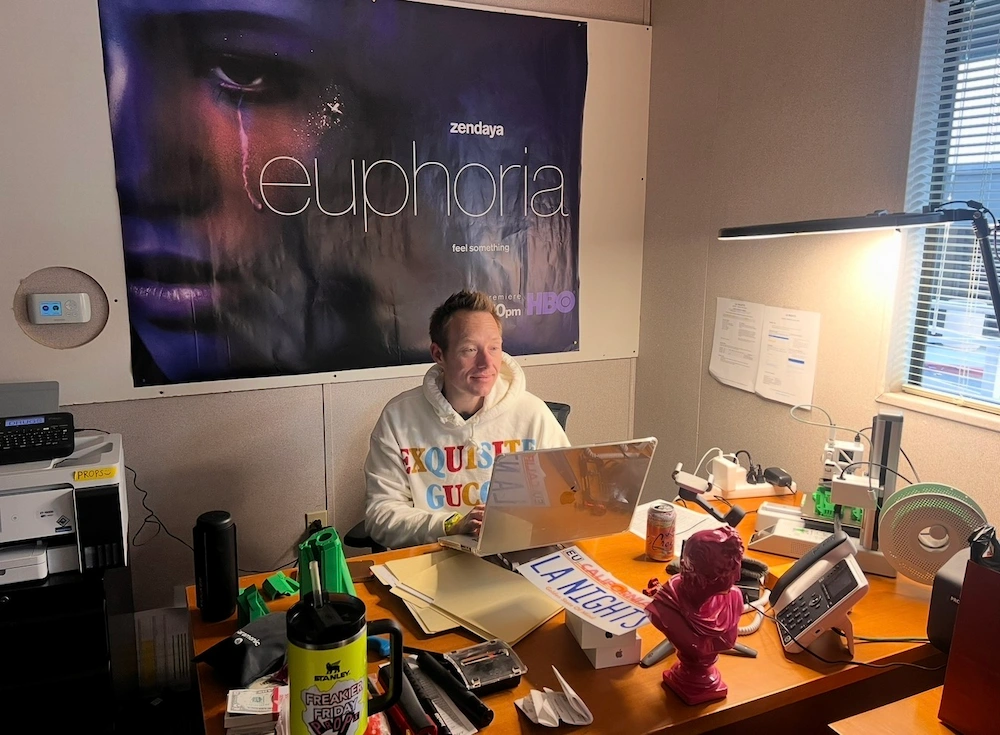
That’s nice that you felt like you could “grow” each character via prop elements from season 2 to season 3?
JB: Yes. This season, I had a different mindset than when I went into season two. I now knew these characters. I knew them, their personalities, their journeys– I knew their pasts.
Talking to Hunter [Schafer, who plays Jules] and asking, “What kind of phone case do you want? Are you feeling like your phone would have these same details?”
She said, “Oh, I like the idea that my character still has anime stickers on her phone.”
When she goes on to be a different person at a different stage in her life, this season–you know, she’s more high-end. So, even things like her character smoking cigarettes, I didn’t want her to just have a pack of cigarettes; I wanted her to have a clamshell case that she’d pull her white filters out of to smoke and a high-end lighter. You know, just giving her that elevated feel of where her character was at the time.
This season we also had [Academy Award-winning fashion icon/costume designer] Colleen Atwood join the crew. She designed Rue’s [Zendaya] vibe, really sticking with that character. So I would work with her regularly to iron out those little details, like, “Is Rue going to wear a watch? Is she going to wear sunglasses or glasses?”
I did’t realize you filmed Don’t Worry Darling during the pandemic?
JB: Yes, that was during COVID. We actually filmed that in the beginning of it. I wrapped on Everything Everywhere All at Once, then we went into lockdown, and three months later, in July of 2020, I started Don’t Worry Darling at the height of COVID, so it was a little bit scary to get into, but it also was so much fun.
I went into it thinking, ” Oh, another period film? 1950s and 1960’s, I’ve got this.“ But it was completely different.
That was Marilyn–old Hollywood glamour. This was mid-century modern, a whole different world. I had to learn what… what type of products they used, and the style of things, how they were designed, and I loved that. I loved shopping for mid-century modern glassware and eyewear, so many cool things that were so beautiful,
I said it before, but it really was so much fun working with Harry [Styles], Florence [Pugh], and Olivia [Wilde].
Olivia was an amazing director. I loved her!
She loved props, so it was, like, one thing we got to always talk about– like, what do we want to do for this? Oh, let’s do… what are your options? Like, well, here’s an entire table of things to pick from. It was like that. We all become very close. It’s almost like we’re on this deserted island together,
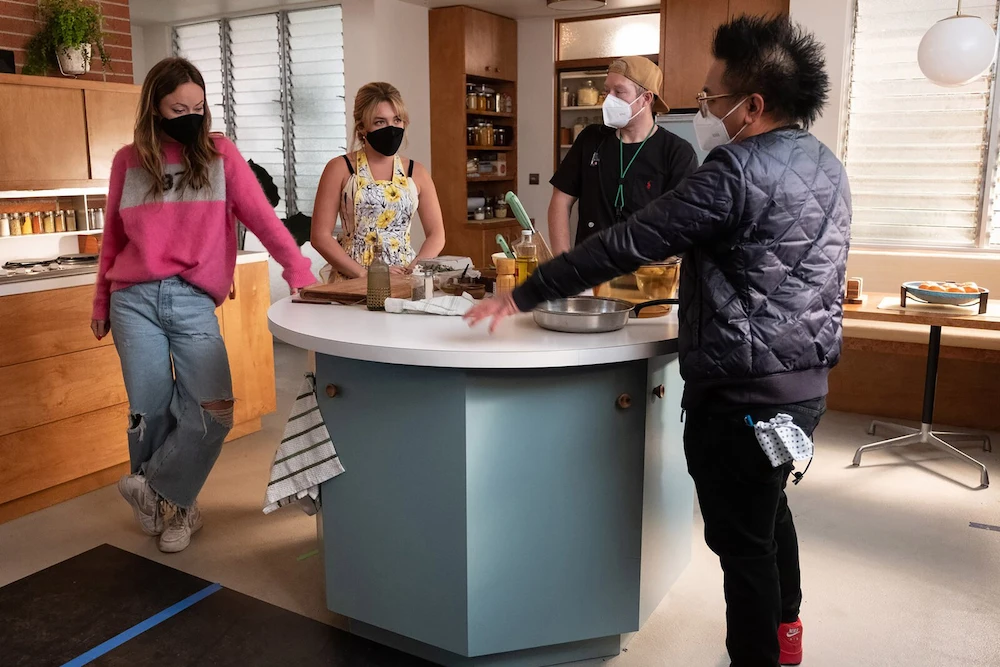
You’ve worked with so many talented people like Jennifer Garner, Zendaya, Michelle Yeoh, Jacob Elordi, Harry Styles, Grace Pugh, etc., etc.. What is it like collaborating so closely with actors and directors?
JB: Honestly, it’s one of my favorite parts of the job.
Some actors love getting involved with props because it helps them shape the character.
I worked closely with Florence Pugh on Don’t Worry Darling. She’s actually an amazing cook, so that helped a lot because her character cooks throughout the film.
And directors all work differently, too. Actor-turned-directors like Olivia Wilde, tend to really understand crew roles because they’ve spent years on sets themselves.
Talk us through your process, what happens before and immediately after you are selected for a project?
JB: Sure. Basically, It starts with me receiving an email from somebody, usually it’s from the director, the production designer, or a producer.
They’ll send me an email, saying, “Hey! We have this project coming up. Are you interested in it? You come highly recommended from so-and-so.”
And I’ll be like, “Yeah, I’d love to read a script.”
They’ll send me an NDA, and then I’ll get the script. I’ll read it. If I like what I see, and if I like the people that are involved, I’ll say yes. Then, the onboarding process begins as well as my own prepping.
I make note of the start date, assess how much prep I’ll need to do, and begin digging in.
it’s a lot of work to break a script down; it’s like a puzzle, but instead of building it you’re pulling out the pieces to start prioritizing the bigger, more time-intensive tasks. Quite often I have to build a lot of the stuff that you see on screen, so I have to make sure I give myself plenty of time to get it done before it’s needed for a scene. You never want to be the cause for a shooting delay.
So, I take that puzzle, dump it on the table, and start putting the outline together. Then, I start plugging in all of the pieces to build the big picture. Sometimes those puzzles are gigantic-1,000 pieces, 5,000 pieces, or more.
“Stay open-minded. The career you end up loving may not be the one you originally expected.”
Each of those puzzle pieces represents a location, a storyline, a character. You have to work backwards, like, where did this person get this? Where were they in their life? Every prop you see on screen is intentional; it is there for a reason and is tied to a story of that character’s journey.
For example, during Freakier Friday, I saw in the script that Jamie [Lee Curtis] and Lindsay [Lohan] were going to have a surfing scene. So, I reached out to a big surfer that was up in Malibu, which was also where those scenes would be shot, and he handcrafted some surfboards for us.
These boards had to be custom because Lindsey had to learn to surf and be comfortable in the water on them. So, we had to get them made to their specific weight and everything, so I got to tap back into my surfing roots when it came to having it for that film and, uh, figuring out the world of surfing again, so that was… that was fun.
Looking back now, how important was your time at The Los Angeles Film School to your career journey?
JB: It was incredibly important because it gave me exposure to the industry and helped me discover where I fit creatively.
More than anything, it helped me build confidence. I went from being someone who loved movies to someone who believed I could actually work in this industry professionally.
That experience really changed the direction of my life.
“Every project taught me something, whether it was a tiny indie film or a major studio production. The budgets got bigger over time, but the mindset stayed the same: do your best work every single time.”
What advice would you give current students or aspiring filmmakers?
JB: Stay curious and stay open-minded.
You might come into school thinking you want to direct or work in sound or editing, but filmmaking is collaborative, and there are so many creative paths people don’t initially know about.
Every project taught me something, whether it was a tiny indie film or a major studio production. The budgets got bigger over time, but the mindset stayed the same: do your best work every single time.
I’d also say: be kind to people.
Film sets are intense environments, and people want to work with individuals who are dependable, collaborative, and positive. Talent matters, but so does how you treat others.
Seriously, I think that one of the reasons that people continue hiring me is because they know I’ll work hard and also be someone they enjoy being around. This industry is built on relationships.
And finally—keep creating. Every student film or small project is helping you grow your skills and relationships taking you closer to your dream career!
How does it feel to go from being that kid in Michigan who loved movies to now working on these critically-acclaimed films and shows?
JB: It’s surreal sometimes.
I grew up watching behind-the-scenes features because I wanted to understand how movie magic worked. Now I’m part of creating those moments for other people.
I used to watch those behind-the-scenes features because I wanted to understand how movies were made. Now I’m creating the kinds of props and moments that people are pausing and analyzing online.
The coolest feeling is knowing something you helped create is emotionally connecting with audiences. That’s why we do this.
Interested in jumpstarting your career in the entertainment industry? Explore our first-in-class film programs today.
