
The Female Gaze is Anamorphic: The Rise of the Female Cinematographer
March is Women’s History Month, a time usually reserved for looking back at the pioneers who paved the way. But this March, the most exciting story isn’t in the past—it’s happening on the biggest screen possible.
With the 98th Academy Awards airing this weekend, history is being written in real-time. For the first time, the concept of the ‘Female Gaze’ is being explored in a literal, technical way – on 65mm film.
For fifty years, film students have debated “The Female Gaze” in theory classes. We’ve analyzed it as a narrative device or a political statement about who is being looked at. But this Women’s History Month, the conversation has shifted. The female gaze is no longer just a metaphor for empathy or softness. It is technical. It is heavy. And thanks to the historic Oscar nomination for Sinners, we know it is anamorphic.
The “65mm Ceiling” Has Shattered
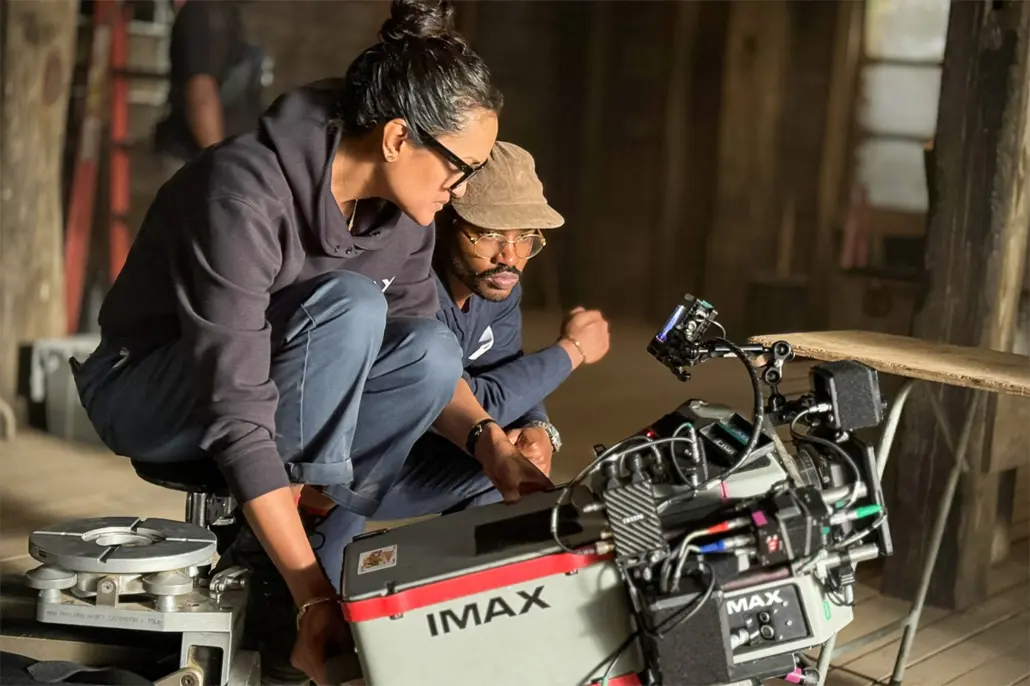
The narrative of the 2026 Oscars is dominated by Autumn Durald Arkapaw. Her nomination for Best Cinematography isn’t just a win for representation; it is a technical flex that has dismantled one of Hollywood’s oldest stereotypes.
For decades, an unspoken bias suggested that female Directors of Photography (DPs) were best suited for intimate, handheld indie dramas—leaving the heavy lifting of IMAX spectacles to men.
Arkapaw didn’t just break that glass ceiling; she blew it up with a 15-perf IMAX camera.
- The Achievement: She is the first female DP to shoot a feature film on large-format IMAX 65mm (15-perf).
- The Tech: On Sinners, she juggled massive aspect ratio shifts—moving from the ultra-wide 2.76:1 (Ultra Panavision) to the towering 1.43:1 (IMAX).
- The Lesson: She proved that the “Female Gaze” can be just as explosive, loud, and technically complex as any traditional blockbuster.
“The Gaze” is Literally a Lens
When we talk about “The Female Gaze” this March, we are being literal. We are talking about the glass.
Anamorphic lenses are famous for capturing a wider field of view, squeezing a massive image onto a standard frame to be “unsqueezed” later. They are the tools of epics. By mastering this format, cinematographers like Arkapaw and Ari Wegner (whose work on Honey Don’t! offers a gritty, noir-inspired counterpoint) are widening the scope of what a “woman’s movie” looks like.
They are expanding the idea of the ‘Female Gaze’ into large-scale cinematic storytelling, showing it can encompass epics and blockbusters.
Who Holds the Keys?
As you watch the ceremony on March 15, pay attention to who is presenting the technical awards. The leadership is changing, too.
With Mandy Walker (Elvis, Snow White) currently serving as the President of the American Society of Cinematographers (ASC), the path from “Camera PA” to “DP” is becoming more transparent.
The Takeaway for LAFS Students
If there is a lesson to be learned from the Class of ’26, it is that versatility is the new signature.
You don’t have to choose between being an “artist” and a “technician.” The most successful cinematographers working today are both. They understand the emotional theory of the gaze and the physics of the lens.
So, when you check out gear this week, remember: The theory is over. The camera is rolling.
Ready to find your own visual language? Check out our Bachelor of Science in Film Production to learn more about our Cinematography concentration.