
The Long Game: How Taylor Black Became One of Streaming’s Most In-Demand Colorists
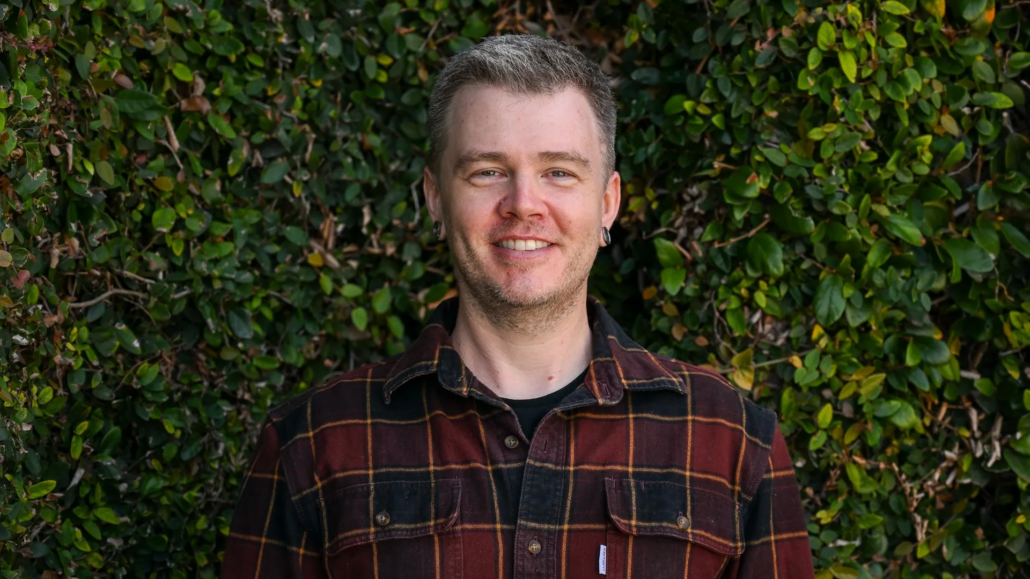
What do recent streaming hits such as Earnhardt (Amazon Prime), John Candy: I Like Me (Amazon Prime), McCartney 3-2-1 (Hulu), Queen of Chess (Netflix), SHAQ (HBO MAX), and The Menendez Brothers (Netflix) all have in common?
None other than our talented Class of 2004 film program alum and senior colorist Taylor Black, who brought his artistic skills to each of those projects and many others, helping to bring to life the literal vision of directors like Colin Hanks (John Candy: I Like Me) in post-production, setting the visual tone for what we would all eventually see on our screens across the biggest streaming platforms.
As an in-demand artist in entertainment, he already has another slate of exciting projects in the works, showing that creative talent paired with a strong work ethic does pay off in this industry.
“I’m currently [working] on a few commercials, another documentary series, and I’ve got dates held for another feature for a director that I’ve worked with previously,”
Taylor recently took time out of his busy schedule of juggling multiple projects, to share his professional journey with us.
THE FIRST RULE OF FIGHT CLUB…
Taylor was born and raised in Minot, North Dakota–a city that was nicknamed the “Magic City” after growing from a tent town into a city overnight in 1887 following the stop of the Great Northern Railroad. His artistic abilities surfaced pretty early. As a child he enjoyed drawing and also played the violin in elementary up until college. He continues to create art in his spare time to this day.
“I’ve always been a visual, artistic person, but I was also good at academics and going into my senior year, I only really had to take one normal class being ahead in credits, so I filled the rest up with art classes and just did art my entire senior year. I also like to cook, and feel like that’s kind of an extension of creativity. I was even considering going to Johnson & Wales University [a premier institution for culinary arts and hospitality education that produced Chef Emeril Lagasse and many other top chefs] “
Yet, it would be his love of film that would steer him down a different path away from culinary school.
“I worked at a movie theater for many years as a projectionist. So, I gained experience building film, putting on the planners, etc. I’d watch every single movie that came out! That was a nice perk. Back then, I also worked at one of our video stores, and as the typical film snob, I’d watch everything I could get my hands on. Any deep cuts out there, I’ve probably taken them home and watched them. My routine was, I’d get off work, walk through the store, pick four to five movies, and I’d stay up till four in the morning just watching movies.”
Were there any films that had an impact on you?
TB: It was that year that I saw The Matrix, which was amazing, but honestly, it was seeing [cinematographer] Jeff Cronenweth’s work on Fight Club and another music video that he’d worked on for Director David Fincher. After watching those, that pretty much sealed it. I wanted to go to film school because I knew that I wanted to work with Jeff at some point.
I loved films by Cinematographer Darius Khondji– really all the old cinematography legends like Lazlo Kovacs and Vittorio Storaro. I also read books like “Writer of Light” by Ray Zone, which covered the whole color and lighting process.
Because I loved photography, I also loved shooting; I was just fascinated with every aspect of being a Director of Photography. There was even a period where I watched films not for the story, but just because “Person X” had worked on it, and I wanted to see what they did and how they shot it, etc.
AN L.A. STORY
Is that when you came out to Los Angeles?
TB: So, instead of coming out to California right away. My parents were like, “Well, why don’t you try something closer to see if you like it?” So, I was looking at the Minneapolis College of Art and Design, which had a photography and cinema studies program, but I ended up choosing Montana State University, Bozeman. I took film and photography classes there, but it just wasn’t for me. I ended up going back to Minot. I got a job as a newspaper photographer. After doing that for a little while, I realized that I didn’t want to stay in my hometown forever. So, I packed up all of my stuff to finally make the move to Los Angeles.
Coming from the Midwest, what was your experience in Los Angeles like?
TB: Well, I got here, and I didn’t know anyone. So, I was just like, ” What do I do?”
For about six months, I worked as an extra. That’s what people do, but I was like, I have to do something more. So, I started looking for film programs and applying. I got into USC’s film program, but when I saw what it would cost, I was like, I’m not gonna do this. Then, I don’t even know how I stumbled upon New York Film Academy. I think it was in the back of “American Cinematographer.”
So. I saw an ad for that, and I was like, I wonder what this is? Similarly, I don’t even remember how I found The L.A. Film School, but I started looking into it and saw that it seemed to be a one-year program, and thought, “This seems really cool.”
I think at that stage, all I had was a portfolio of stills. So, I sent that in, went in for the meetings, and I got in!
Wow, at that time, having access to programs like Media Composer, Pro Tools, etc., which at the time were pretty expensive. So, to be able to get your hands on those was game-changing. We also had real industry people as our editing teachers. Our cinematography instructor was Cinematographer John Hora… he’s huge!
Nice! So, you were a part of one of the first graduating classes from The L.A. Film School. What was that experience like?
TB: Wow, at that time, having access to programs like Media Composer, Pro Tools, etc., which at the time were pretty expensive. So, to be able to get your hands on those was game-changing. We also had real industry people as our editing teachers. Our cinematography instructor was Cinematographer John Hora… he’s huge! To have guys like that, the access that we normally wouldn’t have at that time. This was before digital filmmaking was really a thing, so it was more challenging to get your hands on good equipment, etc. I was happy,
Some of my favorite classes were sound design and sound editing
Also, the environment was great. Everyone in your class is super-duper passionate like you. It’s crazy, but I still talk to everyone that I was friends with in school, pretty much on a daily basis.
WE’LL FIX IT IN POST
After graduating, did you begin working in Post-Production right away?
TB: No. I was initially interested in a career as a Director of Photography, which made finding on-set work feel like the right next step.
Early on, while at school, I became friends with fellow alum, now Cinematographer/Director Brandon Trost. The guy’s insanely talented. He was a few years ahead of me, so when he had already graduated, and he was working in the campus equipment room, I would full focus or load for him on some of his shoots. Then, when he started working on these lower-budget features early on, he’d call us up– you know, the guys that helped him on his student films, and we worked with him. That’s how some of the guys from other classes started going the gripping route. So now and then I’d have work like that, work on projects that lasted a few days.
So, I started going in from 3 a.m. to 7 a.m. before work. Completely unpaid, on my own. Just to hang out with the Dailies’ assist and the Dailies’ colorists. My mentality was “if you want to teach me what you’re doing, I will gladly show up, put in the work, and learn.”
After doing that kind of set work for a little bit, I realized that I didn’t really enjoy the long days and five a.m. call times and decided to start exploring other options.
My roommate at the time was another L.A. Film School Alum, Nick Davis.
Nick was working in Santa Monica at a place called FilmCore Editorial as an assistant editor. He was like, “I can get you an interview at this place, Whitehouse Post.”
I interviewed with them, and they hired me for a temporary PA position. So, I was doing that when Nick let me know about an opportunity at Company 3, another post-production company, and encouraged me to apply. So, I did.
When my two weeks were up at Whitehouse, Company 3 called me. I went in for an interview, and they hired me. I was 23 or 24, and at that point, I initially saw it as just a job. I was still trying to figure out what I wanted to do in film.
Then, Whitehouse also called me and offered me a permanent runner position, but I was already at Company 3, so I decided to stay there. It was there that I started to see how post-production worked and the various roles available. I didn’t know much about post-production, I barely knew what editing was from school. I’d been so focused on Cinematography and DPing that I didn’t really know all of the other roles that existed after the filming/on-set work was done.
However, because I was in the vault early mornings, I started to really notice what the Dailies guys were doing and I wanted to learn that. I was like, “This. I want to do this.”
So, I started going in from 3 a.m. to 7 a.m. before work. Completely unpaid, on my own. Just to hang out with the Dailies’ assist and the Dailies’ colorists. My mentality was “if you want to teach me what you’re doing, I will gladly show up, put in the work, and learn.”
A FULL CIRCLE MOMENT
TB: Then one day, I had the opportunity, because one of the dailies colorists was Jeff Cronenweth’s.colorist. He said to me, “I know Jeff, would you like to go work with him?”
I was like, “Are you kidding me? Yes!”
So, I moved from working in the vault at Company 3 to office production assistant (PA) work at Untitled Entertainment, and when the Cronenweth Brothers had a commercial shoot, I would be a camera PA. I did that for about two and a half years before I decided to return to Company 3 to work in their new scanning department as a Scan and QC Operator, working with ARI scanners, no DaVinci Resolve at the time yet. We were using CLIPSTER and capturing stuff on tapes. It was kind of a rudimentary hookup solution for the old 2K panels. We used that until they eventually got an early version of Resolve.
It was also there that I saw the first music videos filmed on a RED camera come in. No one really knew how to deal with their files, nor how to read the RED codec. But it only took about two more years for RED to be everywhere, taking over the industry.
I remember it was just me and my friend, another Colorist who is now in Chicago, working in that scanning role when that all exploded. He would work one half of the day, and I would work the second half. It was nuts! Everyone went from completing two to three projects in a day, to double at five to six. Once ARRI Alexa entered the mix, everything changed so quickly–almost overnight.
I still found time to keep learning. When the colorists were finishing their projects, I would take a look and dissect what they did. Some of the artists were extremely friendly and willing to answer my questions, show me things, give me tips, and explain how something was done. It was also there that I learned how political and competitive working in entertainment could sometimes be. I learned to navigate those situations diplomatically.
However, I am grateful for the opportunity, as my knowledge base (when it came to coloring) really exploded there–I could do pickups, or a little pre-color for certain artists, learning more and more with each thing that I was allowed to help with.
TRUST THE PROCESS
It’s crazy how far we’ve come technologically! And now you are at Apache, correct?
TB: Yes. While I was at Company 3, I didn’t see long-term growth, so I decided to start exploring other options and ended up working with another L.A. Film School alum, James Cotton, at Local Hero. However, the role was a graveyard shift, so I only did it for a year.
And then I found Apache. When I interviewed, it was with two former Riot and Company 3 Colorists. It felt like they were creating a supportive environment for their teams.
I turned out to be right and really want to reinforce my gratitude for Apache’s founding partners and owners, Steve Rodriguez (also an artist) and LaRue Anderson. They are both incredible people to work alongside and have built a company that truly fosters growth and values its employees and work/life balance—something that is often overlooked in our industry.
They saw something in me early on and gave me my first real opportunity to step into color grading full-time, and they have continued to support and encourage me ever since. When I said that finding Apache was a dream, I truly meant it. I don’t believe I would be where I am today without their belief in me.
Through Apache, it feels like you’ve really been able to establish your own visual identity as a colorist and have gotten to work on some great projects!
TB: So, I started as a Color Assist, to Colorist, and now Senior Colorist. Early on, one of the colorists, Shane Reed, told me, “We want you to grow, we want you to have your own shows.” He was someone I looked up to as a pro. I loved and identified with the way that he graded and colored, as well as his ability to run a room. He was outstanding.
I picked up on what he did. He was always willing to show me new tools or new tricks.
And so the first little bit of, like, hey, can you do this, was on the first season of Chef’s Table.
Back to your culinary roots!
TB: Haha! Yes, I also worked on Street Food: Latin America. That was the first show I got to work on independently.
As a Senior Colorist, what other roles do you interact with on projects?
TB: For long-form, it’s typically the producers, a director, a DP, and an editor in the room with you. For commercials, you’re mostly with copywriters, creative directors, and sometimes an editor or post-supervisor.
Being in a color session, everyone always loves it because it’s a more laid-back experience.
I usually like to put on music; it’s chill, and they just get to watch their footage with the work that I’ve done.
What has been one of your favorite projects to work on?
Mainly because of how iconic he was, and for me, growing up, I’ve seen every one of his movies, like.10 times over. So to do that was such a special thing, just to have any part in that.
This was also the first official documentary from the Candy family, and working with Colin Hanks was so great. He’s outstanding. He can tell a great story, and he’s also just a wonderful person in general. This is also one of a few projects that I’ve worked on with producer Sean Stewart, who is also an amazing producer and great to work with. Those two together made the whole project incredibly seamless and pleasant. Everything about it was a dream. Everyone had fun, everyone was happy. I can’t say enough good things about everyone involved in it.
You seem to be quickly becoming the go-to guy for documentaries and archival pieces. Do you enjoy that genre of film?
TB: Definitely. I like doing archival, because it’s interesting. You are limited with what you can do, so you have to be creative. What makes a visual difference are the small, subtle things like playing with a black level or contrast level. You want to keep that uniformity and seamlessness throughout the piece to keep transitions from becoming jarring.
When you’re cutting between archival, it really is just about respecting the original footage, and, like, with Candy–all of the old movie footage was generally sourced from high-quality sources, so it is just a matter of putting it in and not making any drastic changes. You still have to make sure that nothing is broken, because, like, most of the things we finish are HDR [high dynamic range].
It’s funny because documentaries/docuseries are really having a renaissance lately. Yet, growing up, I don’t think I ever saw a documentary. Now, I’ve seen and worked on so many!
Over the years, acquiring all of the experience has really helped me to grow my confidence.
Not just in artistic choices, but in how I communicate with clients and how I work as part of a team. I’ve definitely gotten more comfortable standing behind my decisions while still being collaborative, remaining open to feedback, and ultimately delivering something that everyone involved can stand behind.
Congratulations on all of these amazing projects. How do you feel that you’ve grown professionally over the years?
TB: I’d say I’ve started to see color less as just making an image look good and more as part of telling the story. guiding the audience’s attention, shaping mood, and supporting the director’s intent.
My style generally gravitates towards more moody, slightly desaturated pastel tones with a film-print kind of feel. I’m really drawn to images that feel atmospheric and intentional.
But at the same time, I’m always open to exploring different looks depending on the needs of the project, that’s half of the fun. I see my job as supporting the story first, not forcing a style onto it, but if someone wants to give me free rein, I’m certainly not going to say no.
Over the years, acquiring all of the experience has really helped me to grow my confidence.
Not just in artistic choices, but in how I communicate with clients and how I work as part of a team. I’ve definitely gotten more comfortable standing behind my decisions while still being collaborative, remaining open to feedback, and ultimately delivering something that everyone involved can stand behind.
With all of that experience that you have now, if you could go back in time to work on a past film, what film(s) would you choose and why?
TB: Oh! That’s so hard. I mean, any of the films that I would pick are already so good, and there’s a reason why I like them. But if I had to pick any, I would choose Saving Private Ryan.
The lenses that Kaminski used on it, everything about that was just perfect. Like, the skip bleach on it. Would I do anything different? I don’t know. If maybe I would, it probably wouldn’t look as good? That’s the thing, whatever I pick, would I do it justice?
Honestly, I probably wouldn’t mind going back and working on the Lord of the Rings films.
There are some things I might tweak in there, but those are… again, I watch those at least, like five or six times a year.
How are you helping to pave the way for the next generation of industry leaders?
TB: While I deeply value the creative and collaborative aspects of my job, a big part of what I enjoy is working with young filmmakers—students, recent graduates, or those taking on their first feature or short film. They bring a fresh enthusiasm that makes the work especially rewarding.
I’ve been fortunate to build strong working relationships with several filmmakers for whom I was their first professional colorist.
Many of them don’t yet have the budgets to work with mid- or higher-tier facilities, so Apache does its best to support them within those constraints.
It’s a meaningful way to build relationships and help foster the next generation of filmmakers. There’s something incredibly fulfilling about helping them get their projects across the finish line and knowing they had a positive enough experience to want to keep creating.
What advice would you give to anyone who wants to follow in your professional footsteps?
TB: If you want to be a colorist, do it the right way.
Because of the availability of online tools and resources, I know a lot of people who just go on YouTube or Reddit and just watch a couple of tutorials and think they know the process. When in reality, there’s so much more to learn. You can take shortcuts, but it’s better to do it the right way. Take the right courses, learn the software, and go assist to get the hands-on learning.
It’s what you have to do in order to learn and improve.
In my case, I just put in the time. I knew it wasn’t gonna be a quick, easy thing, and there was a period of time I didn’t ever expect it to happen. However, the hard work pays off. Someone who can offer you an opportunity will see your drive and initiative. I know I do. To see people, younger kids, do that, I appreciate that, because it’s the exact same thing I did, and I know they are working hard and they have the right work ethic and drive.
Interested in a career like Taylor’s? Check out our Cinematography, Graphic Design, and Film Programs to get your own journey started.
