
Twelve Principles, Ninety Years Later: What Disney’s Animation Rules Still Get Right
Updated September 15th, 2026.
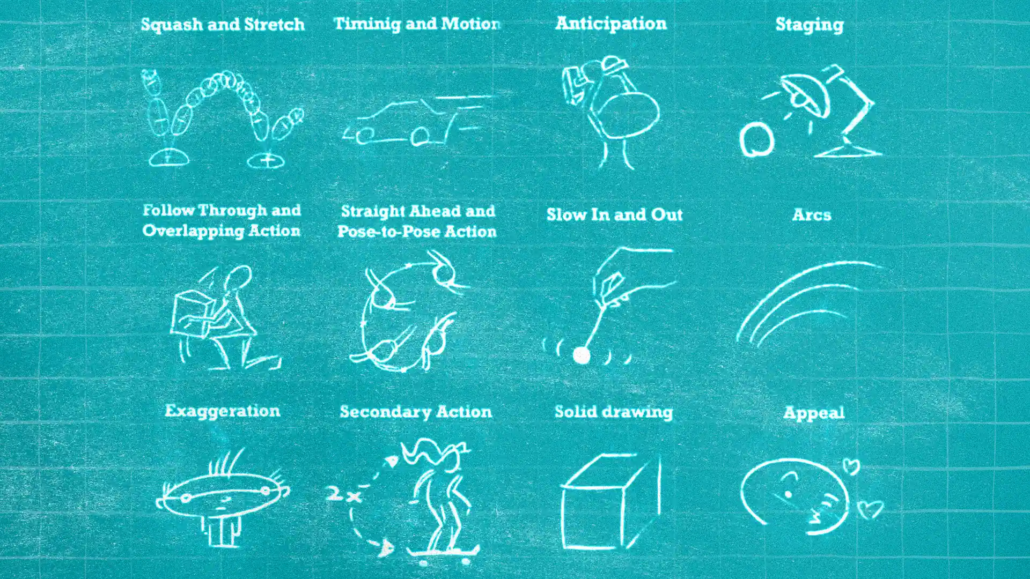
Ninety years ago, a room full of Disney animators was quietly inventing the vocabulary of believable movement, years before anyone wrote it down as a rulebook. The 12 principles of animation wouldn’t be published as a formal list until Frank Thomas and Ollie Johnston’s 1981 book The Illusion of Life, but the techniques trace back to the studio’s earliest experiments with weight, timing, and personality on paper. Today those same rules get quoted in 3D animation software, motion graphics templates, and game engine documentation that nobody working in the 1930s could have possibly imagined. So the real question for a modern animator isn’t whether the rules are old. It’s whether they still work.
A Rulebook Older Than the Technology It Now Governs
Every tool used to make animation has changed at least twice since these principles were formalized. Hand-drawn cels gave way to digital ink-and-paint, then to 3D animation, motion graphics, and now real-time engines that render a scene while you’re still adjusting it.
And yet animation fundamentals courses everywhere, including ours, still open with the same twelve ideas. That’s either a sign of remarkable staying power, or evidence that nobody’s bothered to update the syllabus. It’s worth actually finding out which.
Where Did the 12 Principles of Animation Come From?
Frank and Ollie and the Illusion of Life
Frank Thomas and Ollie Johnston weren’t theorists. They were two of Walt Disney’s Nine Old Men, the animators behind decades of feature work, distilling what they’d learned on the job into The Illusion of Life. The book wasn’t written for a classroom. It was a working record of Disney animation techniques that had already been tested, frame by frame, for half a century.
Rules Written for a Hand-Drawn World
Every principle in that book was solving a hand-drawn problem:
- Solid drawing existed because a flat drawing needed to convincingly fake volume, weight, and perspective on paper.
- In-betweening was a literal job description, the artist filling the frames between an animator’s key poses.
- Squash, stretch, and exaggeration compensated for the fact that a drawn character has no real mass to push against.
Understanding the why behind each rule is the only way to know if it survives the jump to new tools.
Testing the Principles Against Modern Tools
The Question Every Animator Should Ask
Here’s the test worth running on every one of the twelve, whether you’re a first-term student or ten years into a motion design career:
Is this principle describing how the human eye reads motion, or how a 1930s animator worked around the limits of paper and cels?
The first kind is permanent. The second kind needs translation.
Survivors, Workarounds, and Misreadings
Running the twelve through that filter sorts them into three honest categories, and the rest of this article walks through each one:
- Survivors — principles that are really about human perception, so they hold up in any medium.
- Workarounds — principles born from the limits of hand-drawn art, now needing a rethink in 3D and real-time work.
- Misreadings — principles a generation of tutorials flattened into presets, losing the intent along the way.
Which Animation Principles Still Hold Up in Any Medium?
Timing and Spacing as Universal Truths
Timing in animation is arguably the single principle that survives every technology shift untouched. Whether you’re setting keyframe animation by hand or nudging a curve with ease in and ease out, you’re doing the exact same job Frank and Ollie were doing: deciding how fast something should feel, not just how fast it moves. Keyframe interpolation software changed the mechanics, not the judgment call.
Anticipation, Staging, and Appeal Across Any Medium
Anticipation animation cues, clear staging, and genuine appeal all describe how an audience’s eye finds and follows information on screen. That’s a perception problem, not a paper-and-pencil problem, which is why staging and appeal show up identically in a hand-drawn short, a AAA cutscene, and a logo sting. These principles produce believable movement regardless of what’s rendering it.
Which Animation Principles Were Workarounds for Hand-Drawn Art?
Squash and Stretch in a World of Perfect Volumes
Squash and stretch is the poster child for a principle that needs reinterpreting. The squash and stretch principle existed partly to fake elasticity a flat drawing didn’t have. A 3D character rig can preserve volume automatically, so exaggeration has to be a deliberate artistic choice again, not a workaround for the medium’s limitations. Skip that conversation, and 3D character animation reads as stiff, even when it’s technically correct.
Rethinking Solid Drawing for 3D and Real-Time
Solid drawing was about faking convincing weight and balance on a flat page. In 3D, the geometry already has volume, so the principle shifts toward posing, silhouette, and real-time rendering constraints instead of correcting perspective errors that a computer no longer makes.
Which Animation Principles Do Tutorials Most Often Get Wrong?
How “Follow Through” Got Flattened Into a Preset
Follow through and overlapping action is one of the most misread entries on the list. Plenty of tutorials reduced it to “add a bounce curve,” treating it as a button instead of a judgment call about mass, drag, and arcs in animation. The principle was never about the curve. It’s about believable physics tied to a specific character’s weight.
When Secondary Action Becomes Noise
Secondary action is supposed to support the main read of a shot, a flick of a tail, a shift of weight, a held breath. Autogenerated cloth and hair sim have made it easy to bury the primary action under noise instead of supporting it. Animation basics still apply: secondary should whisper, never shout.
How Do the 12 Principles Apply to 3D Animation?
What Changes When the Computer Handles the In-Betweens
Once a computer generates every frame between your keys, the old craft of in-betweening disappears as manual labor and reappears as a design decision: which spacing pattern actually sells the motion. 3D animation artists are still making that call, just with a different toolset.
Where the Old Rules Still Save the Shot
When a 3D shot feels dead, it’s rarely a rigging problem. It’s almost always a classic animation rules problem: missing anticipation, flat timing, or staging that buries the read. These animation techniques are still the first diagnostic tool, long before anyone touches the render settings.
Do the 12 Principles Apply to Motion Graphics?
Applying Character Animation Logic to Type and Shapes
Applying animation principles to motion graphics means treating a logo or a title card with the same discipline as a character. Motion graphics and motion design work has no face to read for appeal, so timing and spacing have to do all the emotional work instead.
Why Ease and Weight Still Matter Without Characters
A shape that snaps into place with no ease reads as broken, not intentional. Timing and spacing animation decisions, borrowed directly from character work, are what separate a polished title sequence from a default template.
How Do Animation Principles Work in Game Engines?
Animating for Interactivity and Player Control
Game animation raises a problem Frank and Ollie never had to solve: the player, not the animator, decides when a move starts. Animation principles in game engines still apply, but every principle has to be engineered to trigger correctly at any moment, not authored to play out on a fixed timeline.
The Tension Between Authored and Systemic Motion
Real-time rendering engines blend hand-authored keyframe animation with procedural systems layered on top. The craft is in making the seams invisible, so a player never feels the handoff between what an artist built and what the engine generated on the fly.
What This Means for Animation Students Today
Learning the Principles Without Worshipping Them
Treat the twelve as animation principles for beginners to learn why they exist, not as commandments. Animation fundamentals are a starting toolkit for judgment, not a checklist to satisfy before a project ships.
Career Paths Across 3D, Motion Graphics, and Games
This isn’t only an animation conversation. A Graphic Design student building a motion identity needs the same timing instincts. An Entertainment Business student tracking a VFX pipeline needs to understand why a shot took three extra passes. A Writing for Film & TV student blocking out a scene benefits from staging and appeal, too. The vocabulary travels well past the animation desk.
How LA Film School Teaches Principles That Outlast the Tools
Grounding Students in Fundamentals and Modern Practice
Our animation program treats the twelve principles as the foundation underneath 3D animation, motion graphics, and real-time work, not a separate unit students check off. Students test these ideas in traditional exercises, then immediately apply them in the software pipelines they’ll actually use on the job, so the judgment carries over even when the toolset doesn’t.
Ready to Learn Animation Principles That Outlast the Tools?
The twelve principles were never really about pencils or paper. They’re about how people read motion and believe in it, which is exactly why they still separate competent animation from animation that actually lands, ninety years on. Learning them deeply — the why behind each one — is what lets your work hold up as the tools keep changing.
At The L.A. Film School, our Animation program treats these fundamentals as the foundation beneath 3D animation, motion graphics, and real-time work — not a unit to check off. Explore it on campus or online, where you’ll test these ideas in traditional exercises and then apply them in the software pipelines you’ll use on the job.
Request Info to explore our programs, or Apply Now and start putting the craft to work.
FAQs: Twelve Principles, Ninety Years Later: What Disney’s Animation Rules Still Get Right
What are the 12 principles of animation?
The 12 principles of animation are a set of foundational guidelines introduced by Disney animators Frank Thomas and Ollie Johnston in their book The Illusion of Life. They include concepts like squash and stretch, anticipation, staging, timing, and appeal, all designed to make animation feel believable and alive. Though created for hand-drawn animation, they remain a cornerstone of animation education today.
Do Disney’s 12 principles still apply to 3D animation?
Many of the 12 principles still apply directly to 3D animation, especially timing, spacing, anticipation, and staging, which are essentially medium-independent. Others, like squash and stretch or solid drawing, need to be reinterpreted for a world of digital models and controlled volumes. Understanding which principles are universal and which were tied to hand-drawn techniques helps modern animators apply them thoughtfully.
Who created the 12 principles of animation?
The 12 principles were developed by Disney animators Frank Thomas and Ollie Johnston, two members of Walt Disney’s famed “Nine Old Men.” They outlined the principles in their 1981 book The Illusion of Life, drawing on decades of studio experience. The principles distilled the techniques that made classic Disney animation feel so lifelike and expressive.
Which animation principles are the most important?
While all twelve are valuable, principles like timing, spacing, anticipation, and staging are often considered the most universal because they apply across virtually every medium and style. These fundamentals shape how motion reads and how believable it feels, whether in hand-drawn work, 3D, motion graphics, or games. Mastering these core ideas provides a strong foundation for any type of animation.
Do the 12 principles apply to motion graphics?
Yes, many of the principles translate well to motion graphics, even without traditional characters. Concepts like timing, spacing, ease, and anticipation give motion a sense of weight and intention, making animated type and shapes feel polished and deliberate. Motion designers frequently rely on these principles to create work that feels dynamic rather than mechanical.
How do the 12 principles work in real-time and game animation?
In real-time and game animation, the principles still guide how motion looks and feels, but they must account for interactivity and player control. Animators balance authored motion, where they control the performance directly, with systemic motion generated by the game engine. Principles like anticipation and follow-through remain important, though they’re applied within the constraints of responsive, interactive gameplay.
Should animation students still learn the 12 principles?
Yes. The 12 principles remain essential for animation students because they teach the fundamentals of believable movement that apply across every tool and technology. The key is to learn them critically, understanding why each principle exists rather than treating them as rigid rules. This foundation prepares students to work confidently across 3D, motion graphics, real-time engines, and whatever tools come next.
